
Alligator Snapping Turtle vs. Common Snapping Turtle
The owner's pair. Both are big snapping turtles of rivers, oxbows and reservoirs in eastern Oklahoma and the Mississippi valley (records share 87 one-degree squares); the Common Snapper is far commoner and often seen crossing roads. A: Three tall, saw-toothed ridges of knobs down the shell, kept for life in the Alligator Snapping Turtle; three low ridges that wear smooth in adults in the Common Snapping Turtle. B: On the sides of the head, ringed by fleshy points; a massive, sharply hooked beak in the Alligator Snapping Turtle; set high on the head, looking up and forward; a smaller beak in the Common Snapping Turtle. C: A pink, worm-like lure on the tongue in the Alligator Snapping Turtle; no lure on the tongue in the Common Snapping Turtle. The Alligator Snapper also has an extra row of small plates between the side plates and the edge of the shell (the Common has none), and rarely leaves the water. Alligator Snappers are protected in Oklahoma. Both bite hard: keep clear of the head.
Open this comparison in Wildsight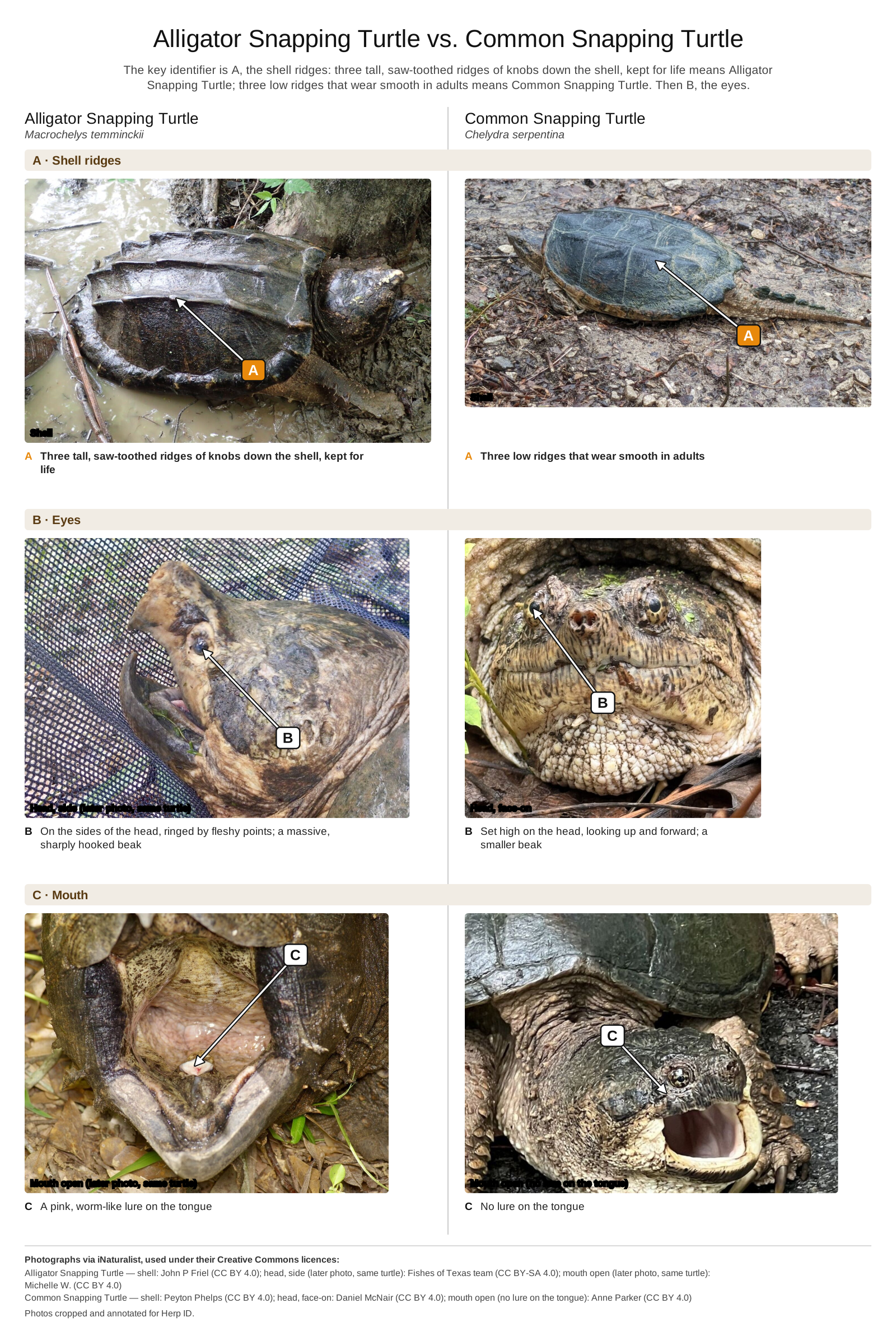
Photographs via iNaturalist under Creative Commons licences; the photographers are credited on the sheet.
More comparisons
- Common Snapping Turtle vs. Eastern Musk Turtle
- Spiny Softshell vs. Common Snapping Turtle
- Smooth Softshell vs. Common Snapping Turtle
- Common Snapping Turtle vs. Painted Turtle
- Common Snapping Turtle vs. Pond Slider
- Common Snapping Turtle vs. Ornate Box Turtle
- Common Snapping Turtle vs. Common Box Turtle
- Common Snapping Turtle vs. River Cooter
- Common Snapping Turtle vs. False Map Turtle
- Common Snapping Turtle vs. Northern Map Turtle
- Common Snapping Turtle vs. Blanding's Turtle
- Common Snapping Turtle vs. Spotted Turtle
- Common Snapping Turtle vs. Ouachita Map Turtle
- Diamondback Terrapin vs. Common Snapping Turtle
- Eastern Mud Turtle vs. Common Snapping Turtle
- Yellow Mud Turtle vs. Common Snapping Turtle
- Suwannee Alligator Snapping Turtle vs. Common Snapping Turtle
Wildsight identifies the reptiles and amphibians of the United States. Every comparison