
Cave Salamander vs. Long-tailed Salamander
Look at the sides of the tail. Scattered round black spots, the same as on the body, means Cave; spots that run together into vertical bars or a herringbone means Long-tailed. Cave is also a deeper orange-red, and its tail grips like a monkey’s; Long-tailed is yellower, with a tail more than half its length.
Open this comparison in Wildsight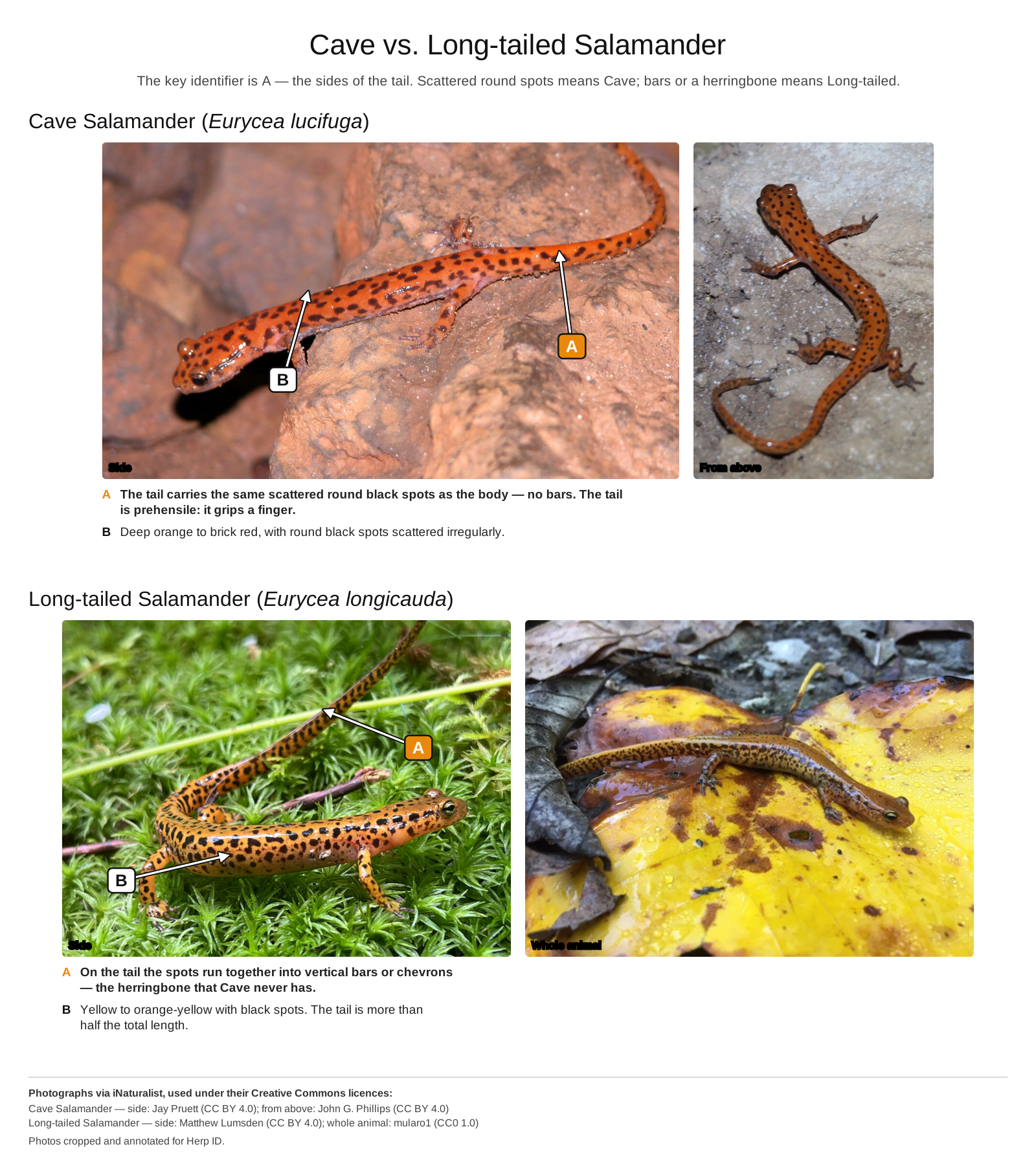
Photographs via iNaturalist under Creative Commons licences; the photographers are credited on the sheet.
More comparisons
- Eastern Newt vs. Cave Salamander
- Red Salamander vs. Cave Salamander
- Midland Mud Salamander vs. Cave Salamander
- Spring Salamander vs. Cave Salamander
- Mud Salamander vs. Cave Salamander
- Dark-sided Salamander vs. Cave Salamander
- Many-ribbed Salamander vs. Cave Salamander
- Northern Grotto Salamander vs. Cave Salamander
- Southern Grotto Salamander vs. Cave Salamander
- Long-tailed Salamander vs. Southern Two-lined Salamander
- Northern Two-lined Salamander vs. Long-tailed Salamander
- Red Salamander vs. Long-tailed Salamander
- Spring Salamander vs. Long-tailed Salamander
- Midland Mud Salamander vs. Long-tailed Salamander
- Mud Salamander vs. Long-tailed Salamander
- Dark-sided Salamander vs. Long-tailed Salamander
- Three-lined Salamander vs. Long-tailed Salamander
- Blue Ridge Two-lined Salamander vs. Long-tailed Salamander
- Junaluska Salamander vs. Long-tailed Salamander
Wildsight identifies the reptiles and amphibians of the United States. Every comparison