
Colorado Checkered Whiptail vs. Great Plains Skink
Their records overlap in southeastern Colorado, the whiptail's native range (checked); in Washington the whiptail is an introduced colony near Moses Lake. A: Six pale stripes; pale spots and bars in the dark fields between them: checkered in the Colorado Checkered Whiptail; large and stout; each scale edged in black, no stripes in the Great Plains Skink. B: Tiny grain-like scales in the Colorado Checkered Whiptail; big shiny scales in oblique rows in the Great Plains Skink.
Open this comparison in Wildsight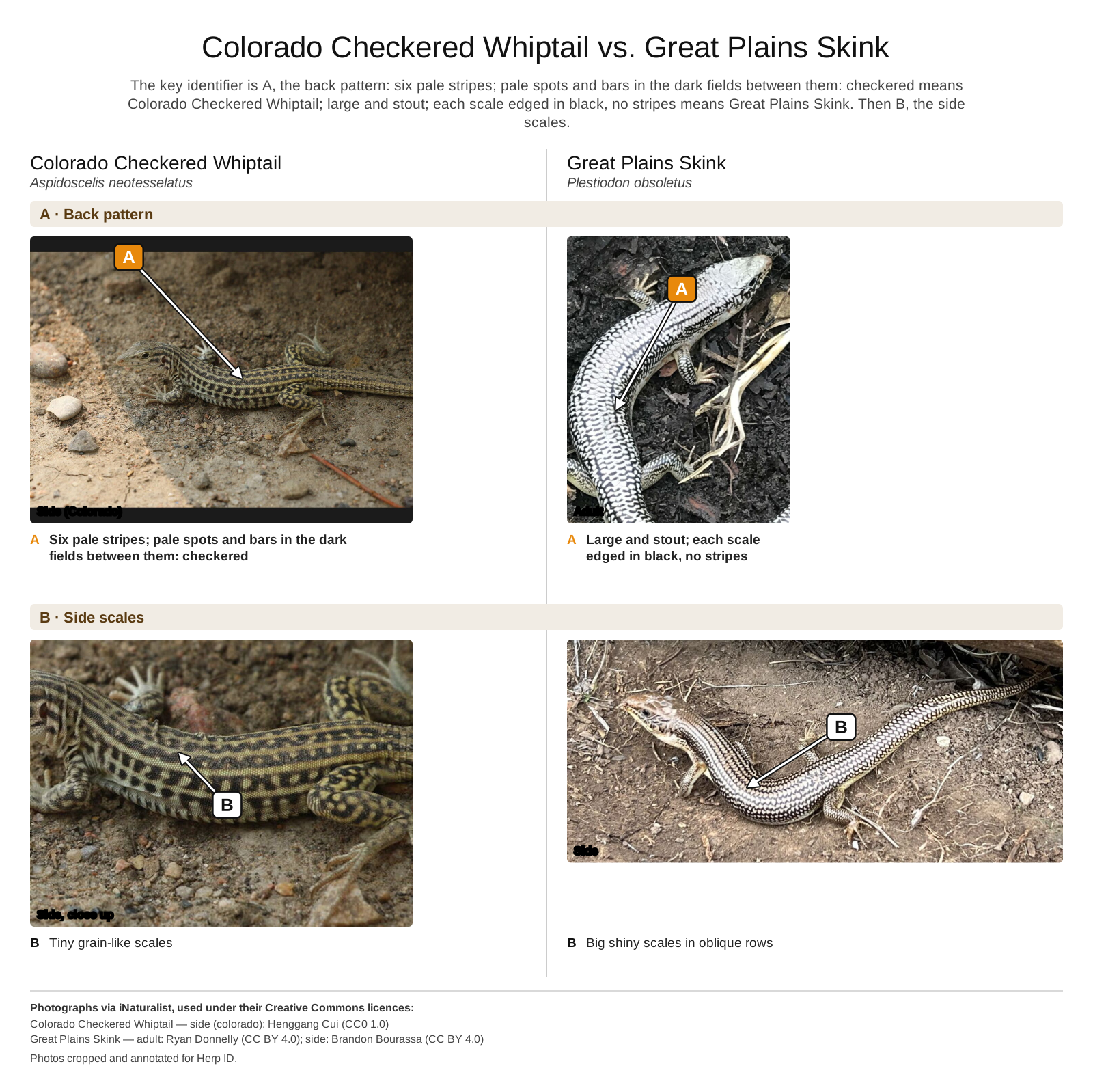
Photographs via iNaturalist under Creative Commons licences; the photographers are credited on the sheet.
More comparisons
- Colorado Checkered Whiptail vs. Six-lined Racerunner
- Colorado Checkered Whiptail vs. Plateau Striped Whiptail
- Colorado Checkered Whiptail vs. Prairie Lizard
- Colorado Checkered Whiptail vs. Plateau Fence Lizard
- Colorado Checkered Whiptail vs. Common Sagebrush Lizard
- Colorado Checkered Whiptail vs. Western Earless Lizard
- Colorado Checkered Whiptail vs. Greater Short-horned Lizard
- Colorado Checkered Whiptail vs. Pygmy Short-horned Lizard
- Colorado Checkered Whiptail vs. Common Side-blotched Lizard
- Colorado Checkered Whiptail vs. Western Skink
- Colorado Checkered Whiptail vs. Many-lined Skink
- Common Checkered Whiptail vs. Colorado Checkered Whiptail
- Great Plains Skink vs. Common Five-lined Skink
- Great Plains Skink vs. Broad-headed Skink
- Great Plains Skink vs. Little Brown Skink
- Great Plains Skink vs. Coal Skink
- Great Plains Skink vs. Prairie Skink
- Many-lined Skink vs. Great Plains Skink
- Mountain Skink vs. Great Plains Skink
- Ocellated Bronze Skink vs. Great Plains Skink
Wildsight identifies the reptiles and amphibians of the United States. Every comparison