
Desert Night Lizard vs. Mediterranean Gecko
Both are small, soft-looking lizards with no eyelids and cat-eye pupils; their records overlap in southern California. A: Slim, no pads in the Desert Night Lizard; wide, flat toe pads in the Mediterranean House Gecko. B: Velvety, with many small black spots in the Desert Night Lizard; raised warts, pale with dark spots in the Mediterranean House Gecko. The gecko climbs walls near lights at night; the night lizard hides under dead yucca and Joshua tree.
Open this comparison in Wildsight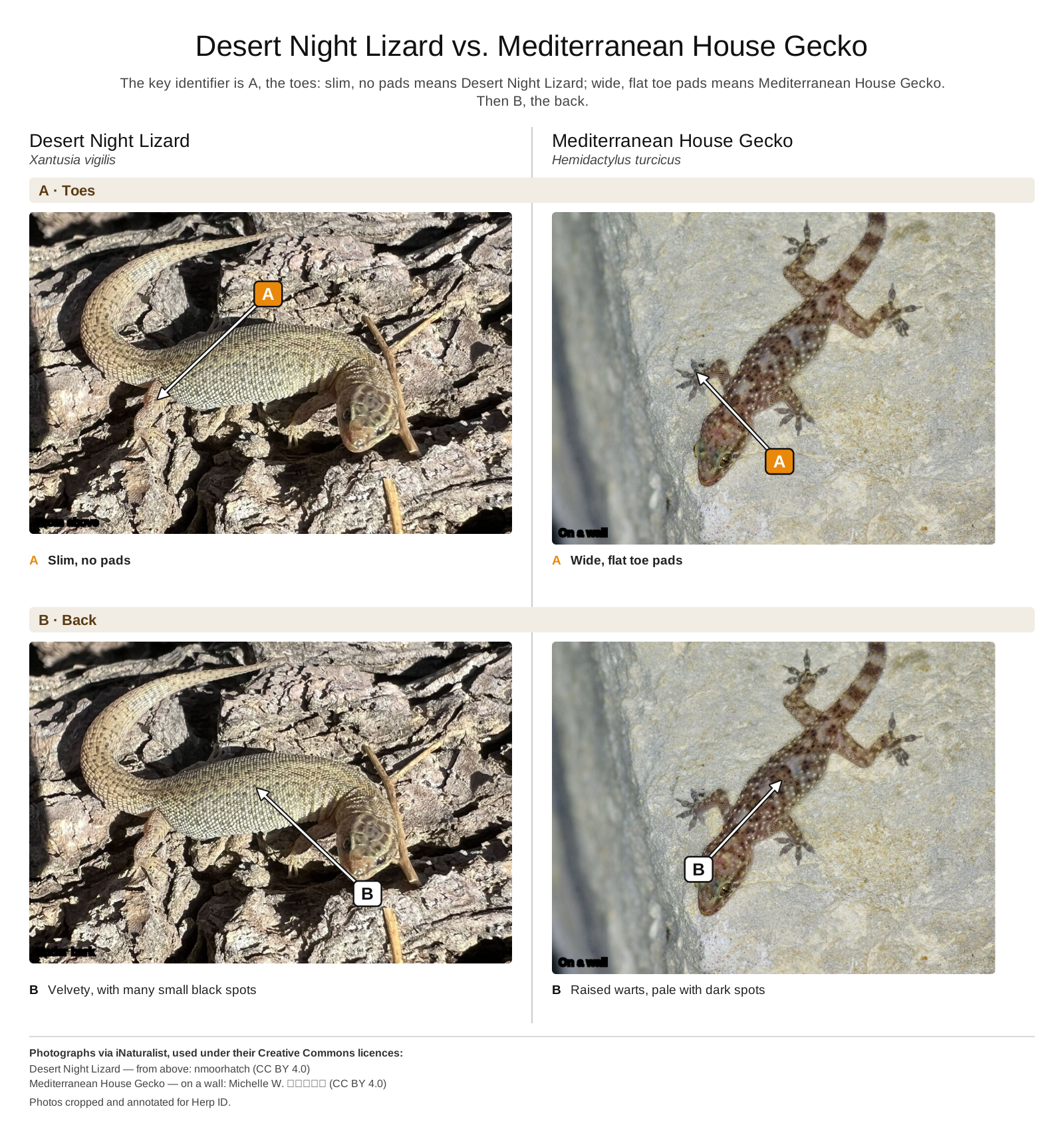
Photographs via iNaturalist under Creative Commons licences; the photographers are credited on the sheet.
More comparisons
- Desert Night Lizard vs. Western Banded Gecko
- Desert Night Lizard vs. Common Side-blotched Lizard
- Granite Night Lizard vs. Desert Night Lizard
- Peninsular Leaf-toed Gecko vs. Desert Night Lizard
- Sandstone Night Lizard vs. Desert Night Lizard
- Baja California Night Lizard vs. Desert Night Lizard
- Sierra Night Lizard vs. Desert Night Lizard
- Barefoot Banded Gecko vs. Desert Night Lizard
- Arizona Night Lizard vs. Desert Night Lizard
- Bezy's Night Lizard vs. Desert Night Lizard
- Western Banded Gecko vs. Mediterranean Gecko
- Peninsular Leaf-toed Gecko vs. Mediterranean Gecko
- Moorish Gecko vs. Mediterranean Gecko
- Flat-tailed House Gecko vs. Mediterranean Gecko
- Keeled Rock Gecko vs. Mediterranean Gecko
- Tropical House Gecko vs. Mediterranean Gecko
- Indo-Pacific House Gecko vs. Mediterranean Gecko
- Sierra Night Lizard vs. Mediterranean Gecko
- Ringed Wall Gecko vs. Mediterranean Gecko
- Texas Banded Gecko vs. Mediterranean Gecko
- Spotted House Gecko vs. Mediterranean Gecko
- Reef Gecko vs. Mediterranean Gecko
- Ashy Gecko vs. Mediterranean Gecko
Wildsight identifies the reptiles and amphibians of the United States. Every comparison