
Eastern Diamond-backed Rattlesnake vs. Timber Rattlesnake
In the piney woods and on the coast the Canebrake form of the Timber Rattlesnake is the only other big rattler; the Florida Museum calls it the one snake the Eastern Diamond-backed is confused with. A: Dark diamonds with brown centres and cream borders in the Eastern Diamond-backed Rattlesnake; dark V-shaped (chevron) crossbands, often a rusty stripe down the spine in the Timber Rattlesnake. B: A dark stripe slanting back through the eye, edged above and below by a pale cream line in the Eastern Diamond-backed Rattlesnake; plain; at most a faint dark band behind the eye, without pale edges in the Timber Rattlesnake. C: Grey or brown with dark bands before the rattle in the Eastern Diamond-backed Rattlesnake; solid velvety black before the rattle in the Timber Rattlesnake. Young Eastern Diamond-backs already carry bold pale-edged diamonds. Both are venomous: watch them from a distance.
Open this comparison in Wildsight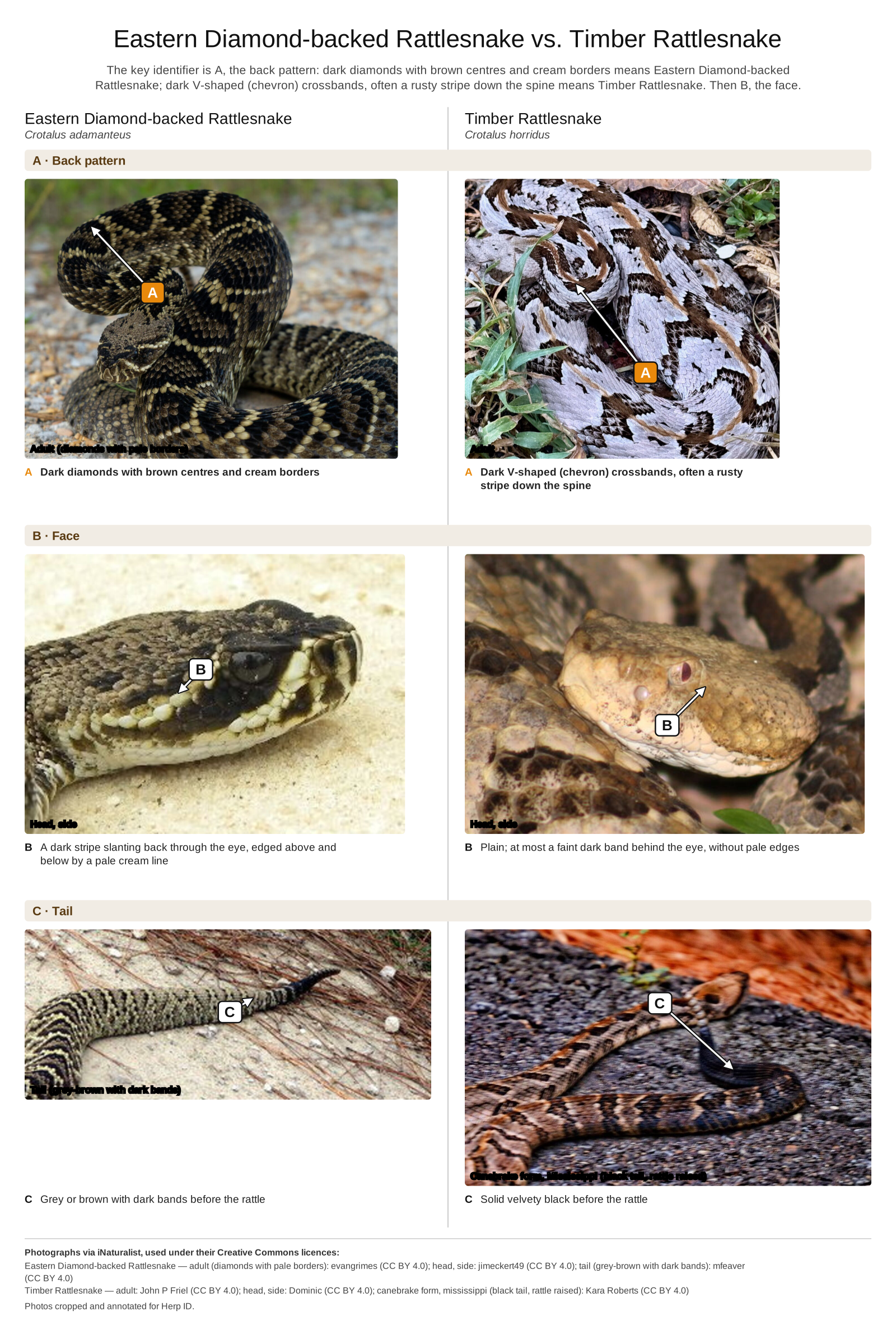
Photographs via iNaturalist under Creative Commons licences; the photographers are credited on the sheet.
More comparisons
- Eastern Diamond-backed Rattlesnake vs. Pygmy Rattlesnake
- Eastern Black-tailed Rattlesnake vs. Timber Rattlesnake
- Pygmy Rattlesnake vs. Timber Rattlesnake
Wildsight identifies the reptiles and amphibians of the United States. Every comparison