
Eastern Foxsnake vs. Central Ratsnake
Adults are easy: an adult Foxsnake is sandy-tan or yellowish with large dark blotches and a rusty or copper-red head, and an adult Central Ratsnake is black with a white chin. The young are harder, since both are grey-blotched. Look at the blotches: rounded or oval on a young Foxsnake, sharper and saddle-shaped on a young Ratsnake, pinching or pointing at the sides like a sheriff's badge. The young Foxsnake often has a dark bar under the eye, and its head turns rusty as it grows; a young Ratsnake's head stays grey like its body, with a dark stripe from the eye back to the jaw, and darkens as it grows. The belly helps too: yellow checked with black for Foxsnake, white with dark checks for Ratsnake. In Indiana the Foxsnake is a northern snake of marsh edges and fields.
Open this comparison in Wildsight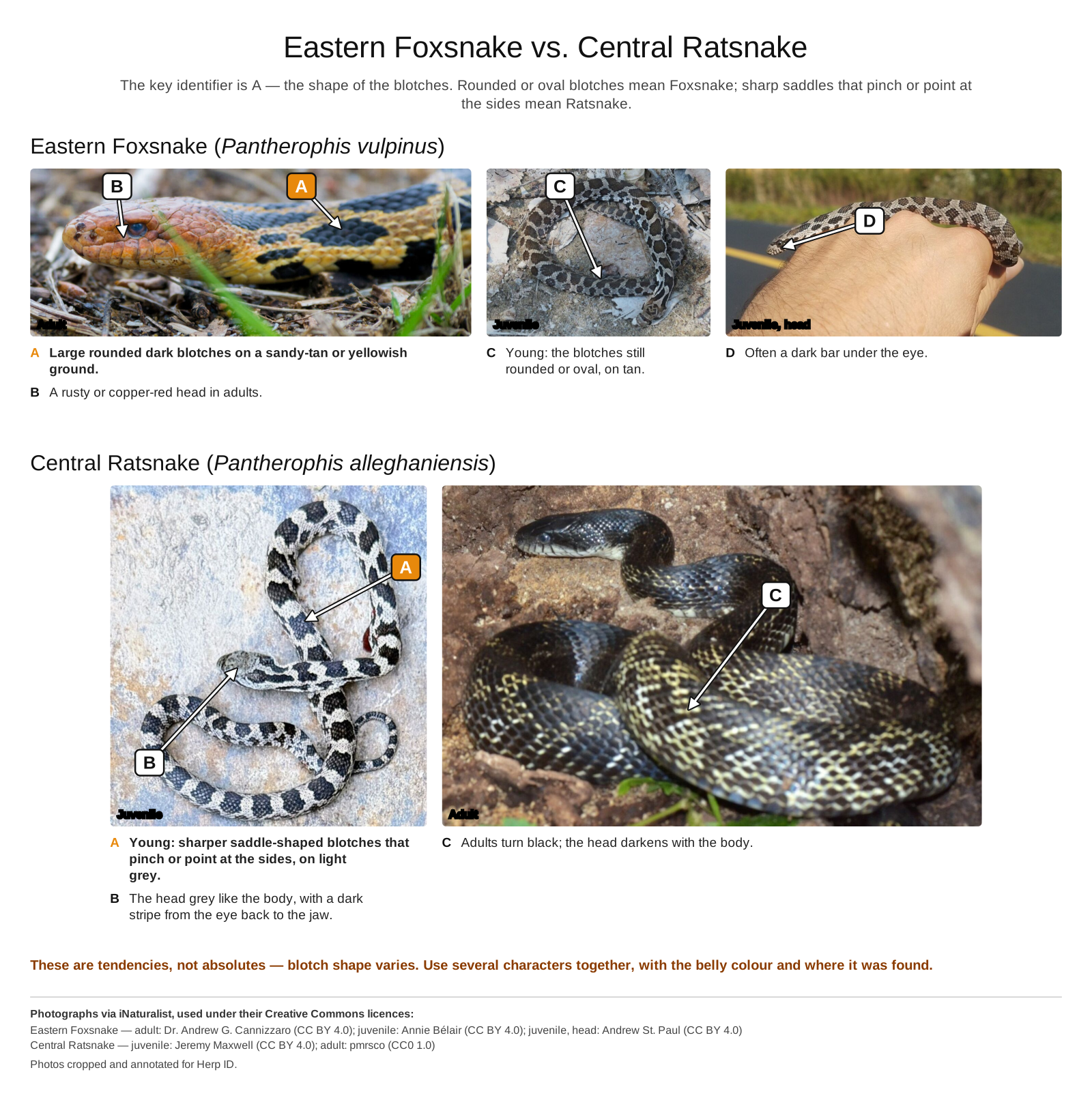
Photographs via iNaturalist under Creative Commons licences; the photographers are credited on the sheet.
More comparisons
- Eastern Foxsnake vs. Eastern Milksnake
- Black Kingsnake vs. Central Ratsnake
- Eastern Milksnake vs. Central Ratsnake
- North American Racer vs. Central Ratsnake
- Prairie Kingsnake vs. Central Ratsnake
- Red Cornsnake vs. Central Ratsnake
- Northern Pinesnake vs. Central Ratsnake
- Eastern Kingsnake vs. Central Ratsnake
- Great Plains Ratsnake vs. Central Ratsnake
- Mole Kingsnake vs. Central Ratsnake
- Eastern Ratsnake vs. Central Ratsnake
Wildsight identifies the reptiles and amphibians of the United States. Every comparison