
Gilbert's Skink vs. Western Skink
Both live under rocks and logs across much of California; their records overlap widely. A: Plain olive or brown; the stripes of the young have faded in the Gilbert's Skink; bold pale stripes edging a broad brown band, kept into adulthood in the Western Skink. B: Pink, orange or red in many young (blue in others) in the Gilbert's Skink; always blue in the young, often still blue in adults in the Western Skink. C: Blackish bands between the pale stripes, no wide brown band in the Gilbert's Skink; a wide brown band down the middle, edged black, between the pale stripes in the Western Skink. Breeding male Gilbert's Skinks have a red or orange head. A small, blue-tailed young one can still be hard to place: Gilbert's grows larger and loses its stripes, so a large striped skink is a Western; where both live, the brown back band is the best clue.
Open this comparison in Wildsight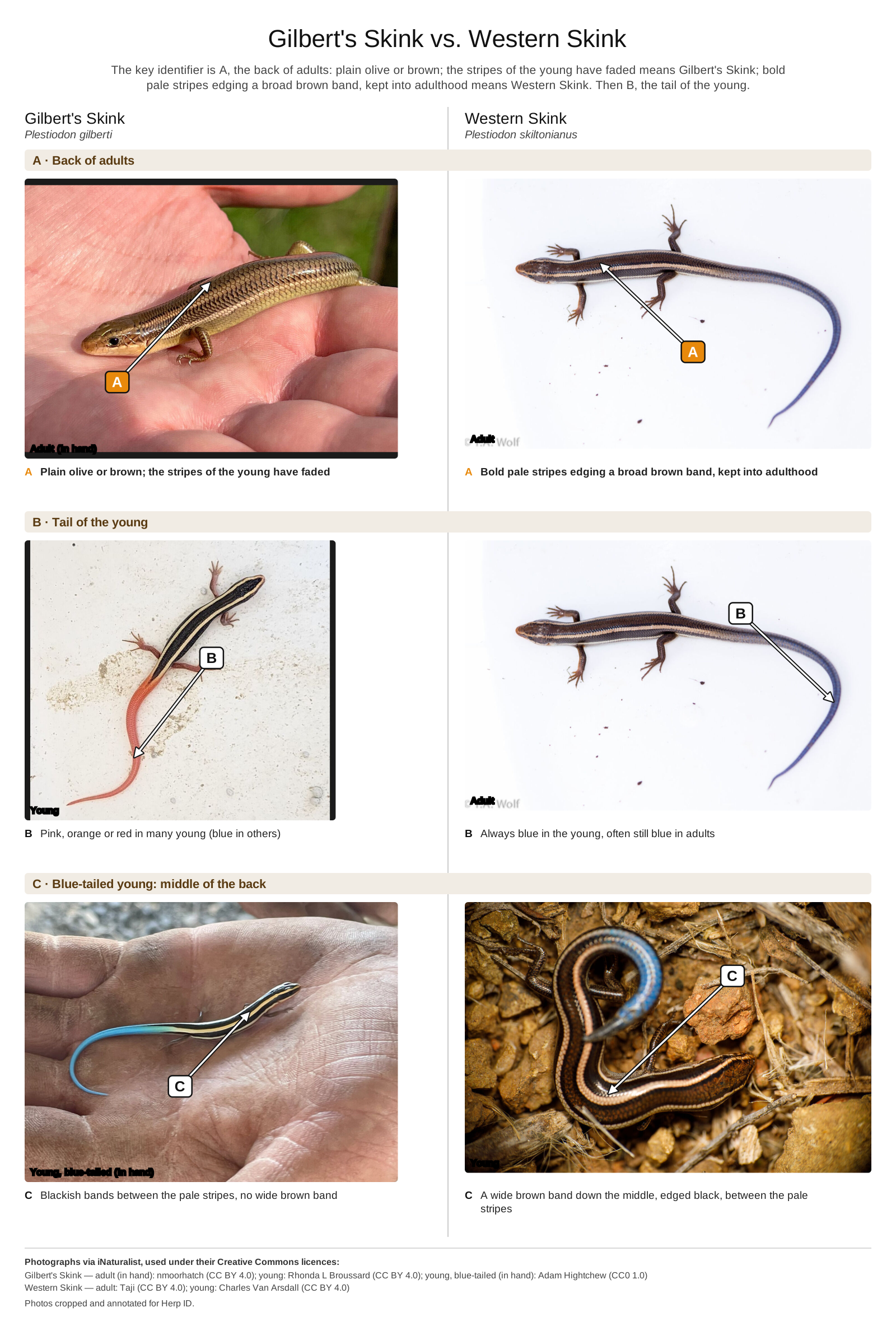
Photographs via iNaturalist under Creative Commons licences; the photographers are credited on the sheet.
More comparisons
- Orange-throated Whiptail vs. Gilbert's Skink
- Sonoran Spotted Whiptail vs. Gilbert's Skink
- African Five-lined Skink vs. Gilbert's Skink
- Western Skink vs. Many-lined Skink
- Northern Alligator Lizard vs. Western Skink
- Southern Alligator Lizard vs. Western Skink
- Colorado Checkered Whiptail vs. Western Skink
- Orange-throated Whiptail vs. Western Skink
- Sonoran Spotted Whiptail vs. Western Skink
- African Five-lined Skink vs. Western Skink
Wildsight identifies the reptiles and amphibians of the United States. Every comparison