
Gray-banded Kingsnake vs. Rock Rattlesnake
The Gray-banded Kingsnake looks much like the Mottled Rock Rattlesnake that shares its limestone slopes (it is thought to mimic it). A: Narrow, barely wider than the neck; round pupils; no pit in the Gray-banded Kingsnake; broad and triangular on a thin neck, with a pit between the eye and the nostril in the Rock Rattlesnake. B: Thin and tapering, no rattle in the Gray-banded Kingsnake; a rattle in the Rock Rattlesnake. C: Clean black bands on blue-grey, often with orange saddles in the Gray-banded Kingsnake; jagged dark crossbands with dark flecks between in the Rock Rattlesnake.
Open this comparison in Wildsight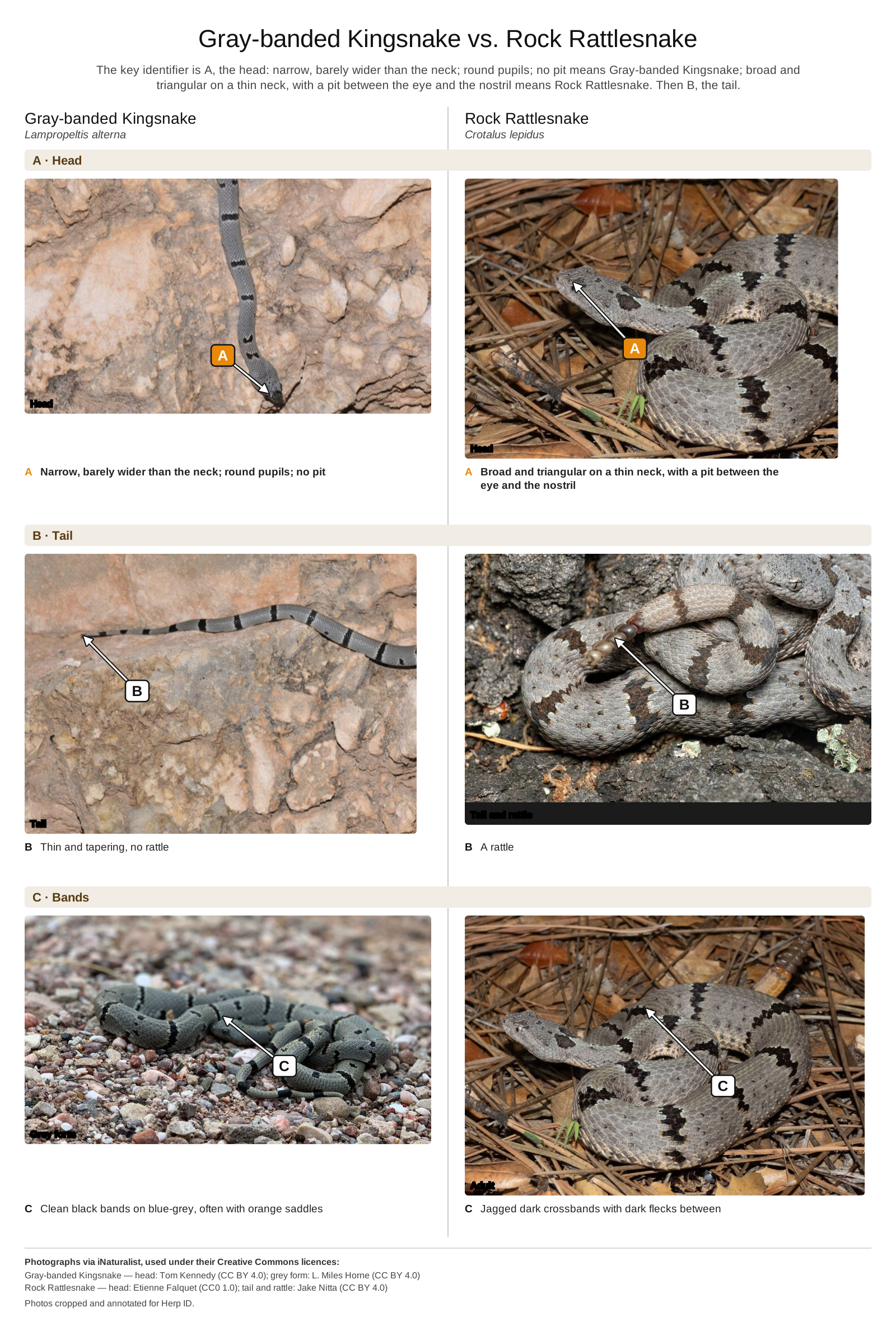
Photographs via iNaturalist under Creative Commons licences; the photographers are credited on the sheet.
More comparisons
- Texas Lyre Snake vs. Gray-banded Kingsnake
- Gray-banded Kingsnake vs. Western Milksnake
- Western Black-tailed Rattlesnake vs. Rock Rattlesnake
- Tiger Rattlesnake vs. Rock Rattlesnake
- Rock Rattlesnake vs. Western Diamond-backed Rattlesnake
- Rock Rattlesnake vs. Gopher Snake
- Rock Rattlesnake vs. Sonoran Lyre Snake
- Rock Rattlesnake vs. Arizona Black Rattlesnake
- Rock Rattlesnake vs. Desert Nightsnake
- Rock Rattlesnake vs. Prairie Rattlesnake
- Rock Rattlesnake vs. Western Massasauga
- Rock Rattlesnake vs. Mojave Rattlesnake
- Rock Rattlesnake vs. Sidewinder
- Rock Rattlesnake vs. Southwestern Speckled Rattlesnake
- Chihuahuan Nightsnake vs. Rock Rattlesnake
- Ridge-nosed Rattlesnake vs. Rock Rattlesnake
- Twin-spotted Rattlesnake vs. Rock Rattlesnake
- Eastern Black-tailed Rattlesnake vs. Rock Rattlesnake
- Texas Lyre Snake vs. Rock Rattlesnake
Wildsight identifies the reptiles and amphibians of the United States. Every comparison