
Mojave Shovelnose Snake vs. Ground Snake
Both live in the Mojave Desert and its mountains, from California into Nevada and Arizona; their records overlap there. A: Flat and shovel-shaped, the lower jaw set back under it in the Mojave Shovelnose Snake; rounded, an ordinary snake's snout in the Ground Snake. B: Always banded: 21 or more narrow black or brown bands on cream or yellow in the Mojave Shovelnose Snake; very variable; banded ones have fewer, wider bands, often with orange saddles in the Ground Snake. C: Never plain: bands right down the body in the Mojave Shovelnose Snake; many are plain orange, tan or grey, some with a dark head in the Ground Snake. Both are small (under 18 in), harmless, and out at night on sand and gravel.
Open this comparison in Wildsight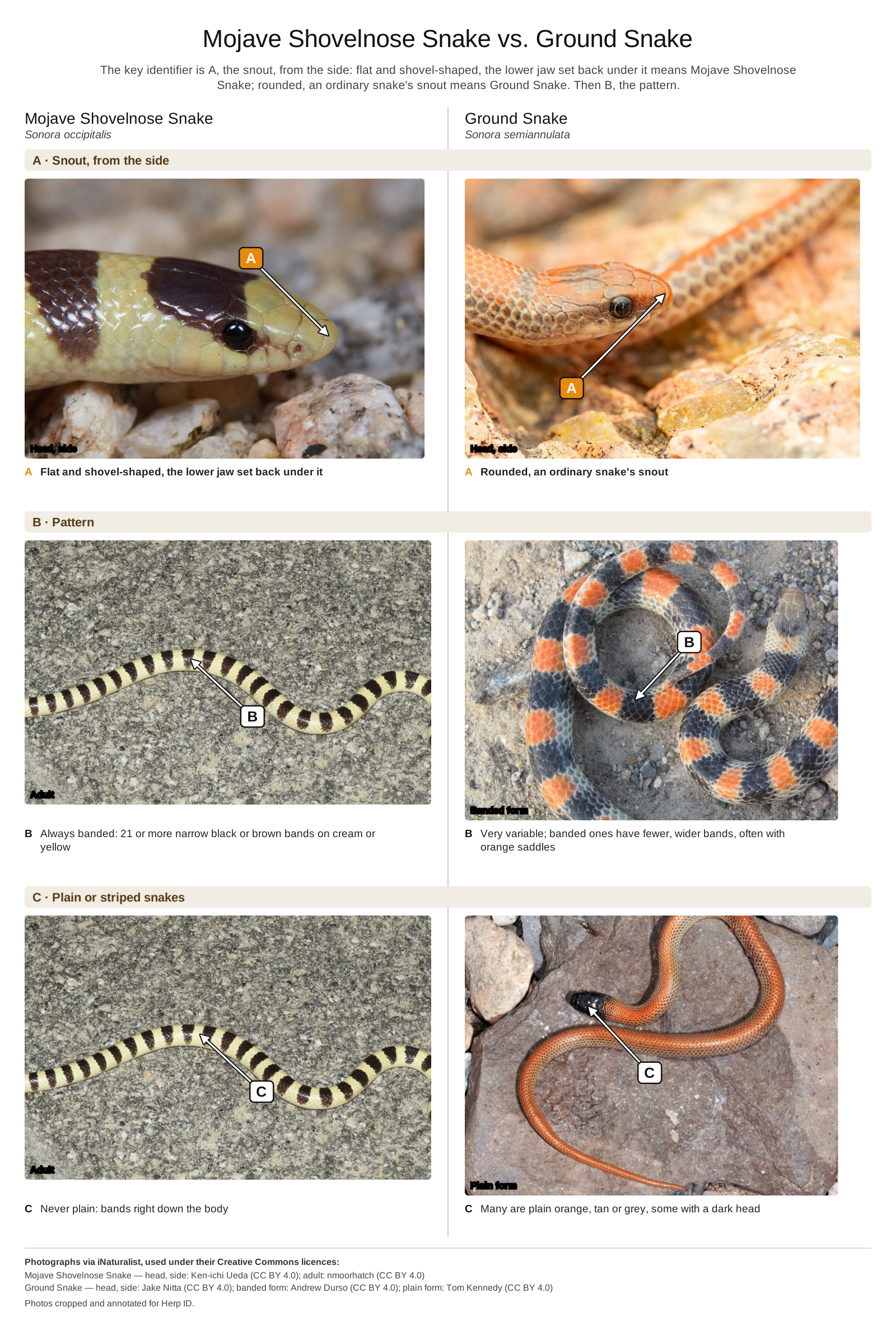
Photographs via iNaturalist under Creative Commons licences; the photographers are credited on the sheet.
More comparisons
- Mojave Shovelnose Snake vs. Long-nosed Snake
- Mojave Shovelnose Snake vs. Colorado Desert Shovelnose Snake
- Ground Snake vs. Western Milksnake
- Long-nosed Snake vs. Ground Snake
- California Kingsnake vs. Ground Snake
- California Mountain Kingsnake vs. Ground Snake
- Colorado Desert Shovelnose Snake vs. Ground Snake
- Western Black-headed Snake vs. Ground Snake
- Southwestern Blackhead Snake vs. Ground Snake
- Ground Snake vs. Coast Mountain Kingsnake
- Sonoran Coralsnake vs. Ground Snake
- Arizona Mountain Kingsnake vs. Ground Snake
- Banded Sand Snake vs. Ground Snake
- Chihuahuan Mountain Kingsnake vs. Ground Snake
- Saddled Leafnose Snake vs. Ground Snake
- Chihuahuan Hook-nosed Snake vs. Ground Snake
- Great Plains Ground Snake vs. Ground Snake
Wildsight identifies the reptiles and amphibians of the United States. Every comparison