
Scott Bar Salamander vs. Del Norte Salamander
Both are long, slim, short-legged woodland salamanders; their records touch in the Klamath Mountains. A: 17 to 18 (usually 17); a slightly stockier, shorter trunk in the Scott Bar Salamander; 18 to 20 (usually 19); a noticeably longer trunk in the Del Norte Salamander. B: Shorter toes, joined by webbing that reaches farther toward the tips (no open photo shows the toes clearly) in the Scott Bar Salamander; longer, thinner toes with little webbing (no open photo shows the toes clearly) in the Del Norte Salamander. C: Longer legs: a gap of 5.5 to 7.5 costal folds in the Scott Bar Salamander; shorter legs: a gap of 6.5 to 8.5 costal folds in the Del Norte Salamander. D: Dull, indistinct or heavily flecked: dark brownish-red to dull bronze, stippled slate and specked white or gold in the Scott Bar Salamander; usually broad and crisp, reddish-orange to chestnut (fading in old adults) in the Del Norte Salamander.
Open this comparison in Wildsight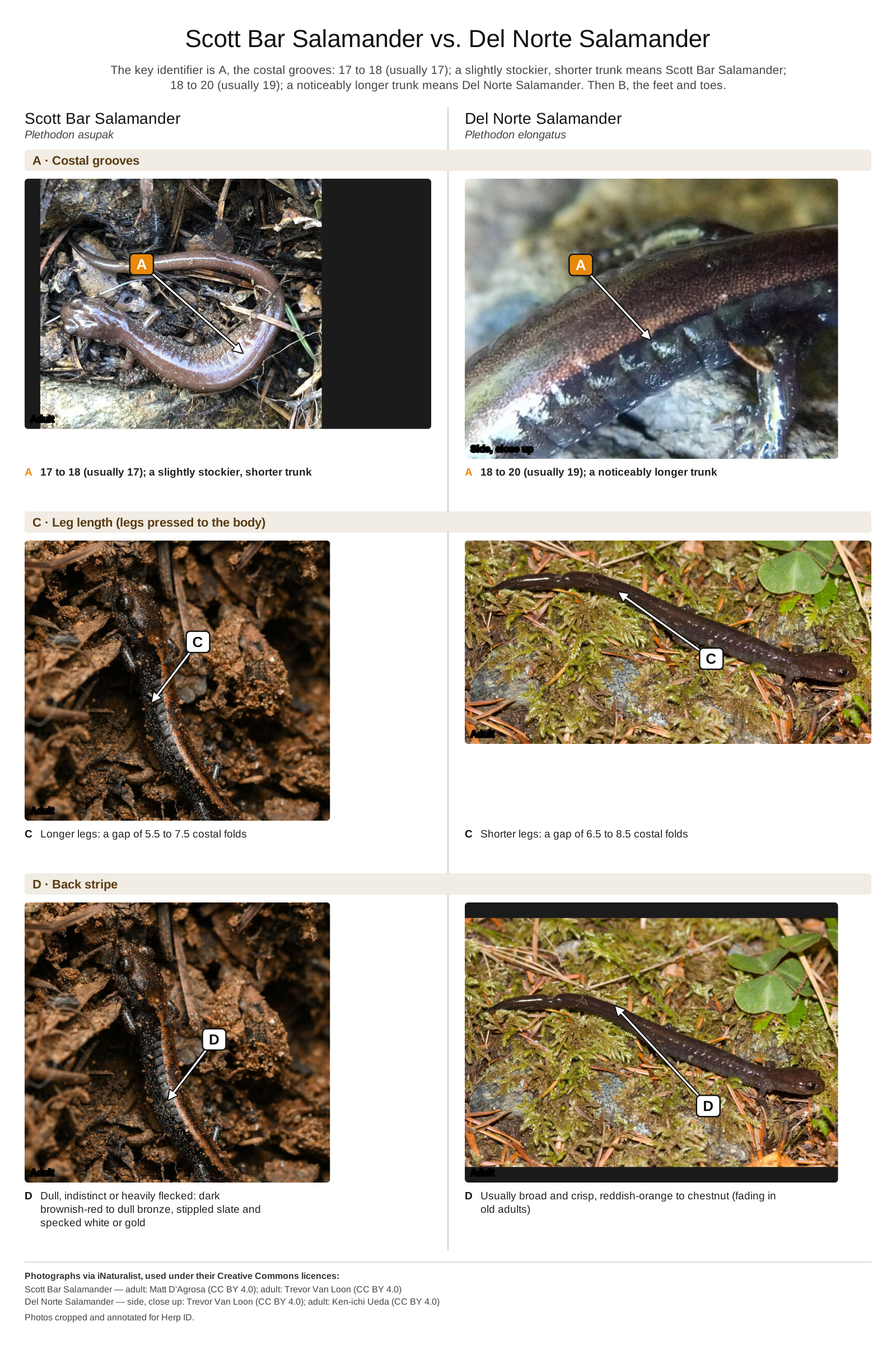
Photographs via iNaturalist under Creative Commons licences; the photographers are credited on the sheet.
More comparisons
- Scott Bar Salamander vs. Clouded Salamander
- Scott Bar Salamander vs. Dunn's Salamander
- Scott Bar Salamander vs. Ensatina
- Scott Bar Salamander vs. Klamath Black Salamander
- Scott Bar Salamander vs. Wandering Salamander
- Del Norte Salamander vs. Western Red-backed Salamander
- Del Norte Salamander vs. Dunn's Salamander
- Del Norte Salamander vs. Clouded Salamander
- Del Norte Salamander vs. Southern Torrent Salamander
- Del Norte Salamander vs. Siskiyou Mountains Salamander
- Del Norte Salamander vs. Klamath Black Salamander
- Del Norte Salamander vs. California Slender Salamander
- Wandering Salamander vs. Del Norte Salamander
- Ensatina vs. Del Norte Salamander
- Speckled Black Salamander vs. Del Norte Salamander
Wildsight identifies the reptiles and amphibians of the United States. Every comparison