
Shasta Black Salamander vs. Klamath Black Salamander
Both are sturdy black climbing salamanders; their records meet in Shasta and Siskiyou counties. A: Bold medium-to-large brassy, yellow or cream spots on charcoal-black in the Shasta Black Salamander; very fine silver, white or icy-blue specks on slate-grey to black in the Klamath Black Salamander. B: Bright yellow patches at the bases of the legs and a brassy-gold wash (no open photo of a young one) in the Shasta Black Salamander; a plain greenish-olive or bronze wash, no yellow leg patches in the Klamath Black Salamander. C: Light grey to yellowish-slate, clearly paler than the back (no open photo shows it) in the Shasta Black Salamander; dark slate-grey to charcoal, only a little paler than the back, finely dusted silver (no open photo shows it) in the Klamath Black Salamander. D: Broad, square-tipped pads for climbing limestone cracks in the Shasta Black Salamander; broad, square-tipped pads (for granite and metamorphic talus) in the Klamath Black Salamander. Range decides where they meet: Shasta Lake and the upper Sacramento (Shasta Black) vs the Klamath region (Klamath Black).
Open this comparison in Wildsight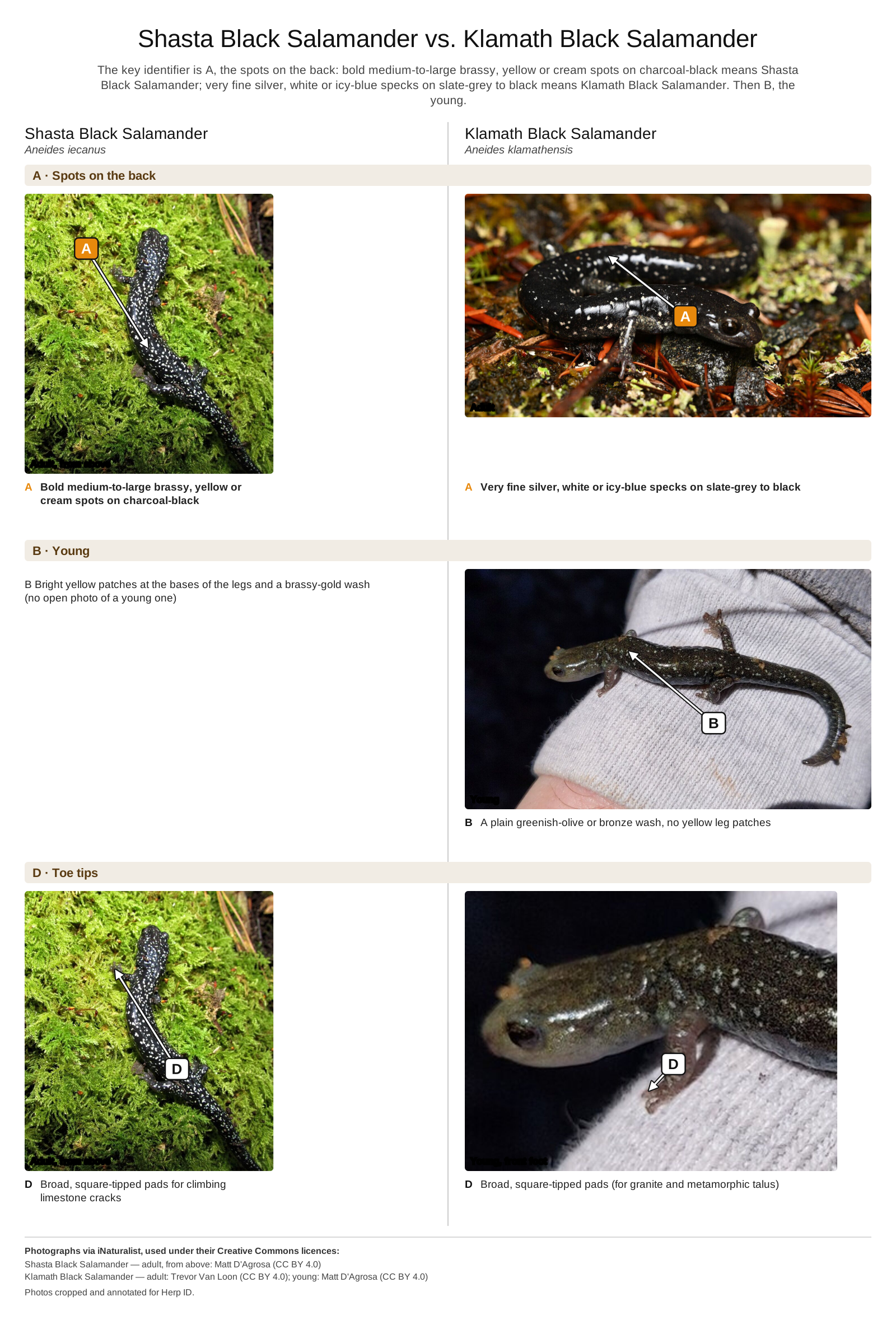
Photographs via iNaturalist under Creative Commons licences; the photographers are credited on the sheet.
More comparisons
- Samwel Shasta Salamander vs. Shasta Black Salamander
- Shasta Salamander vs. Shasta Black Salamander
- Shasta Black Salamander vs. Ensatina
- Wintu Shasta Salamander vs. Shasta Black Salamander
- Del Norte Salamander vs. Klamath Black Salamander
- Siskiyou Mountains Salamander vs. Klamath Black Salamander
- Klamath Black Salamander vs. Clouded Salamander
- Arboreal Salamander vs. Klamath Black Salamander
- Klamath Black Salamander vs. Wandering Salamander
- Klamath Black Salamander vs. Speckled Black Salamander
- Scott Bar Salamander vs. Klamath Black Salamander
- Wintu Shasta Salamander vs. Klamath Black Salamander
Wildsight identifies the reptiles and amphibians of the United States. Every comparison