
West Virginia Spring Salamander vs. Spring Salamander
Spring Salamanders live in the same cave stream, their larvae have gills too, and the two sometimes cross (Campbell Grant et al. 2022). A: Tiny eyes for its size; big larvae barely react to sight in the West Virginia Spring Salamander; normal-sized eyes in the Spring Salamander. B: Pale pinkish-tan, with a faint darker net and small pale spots in the West Virginia Spring Salamander; darker brownish, mottled in the Spring Salamander. C: Larvae grow past 4 in from snout to vent before they change in the West Virginia Spring Salamander; larvae rarely past 3 in from snout to vent in the Spring Salamander. D: Faint or missing on the pale skin in the West Virginia Spring Salamander; grown animals: a clear pale line, edged in dark, from the eye to the nostril in the Spring Salamander.
Open this comparison in Wildsight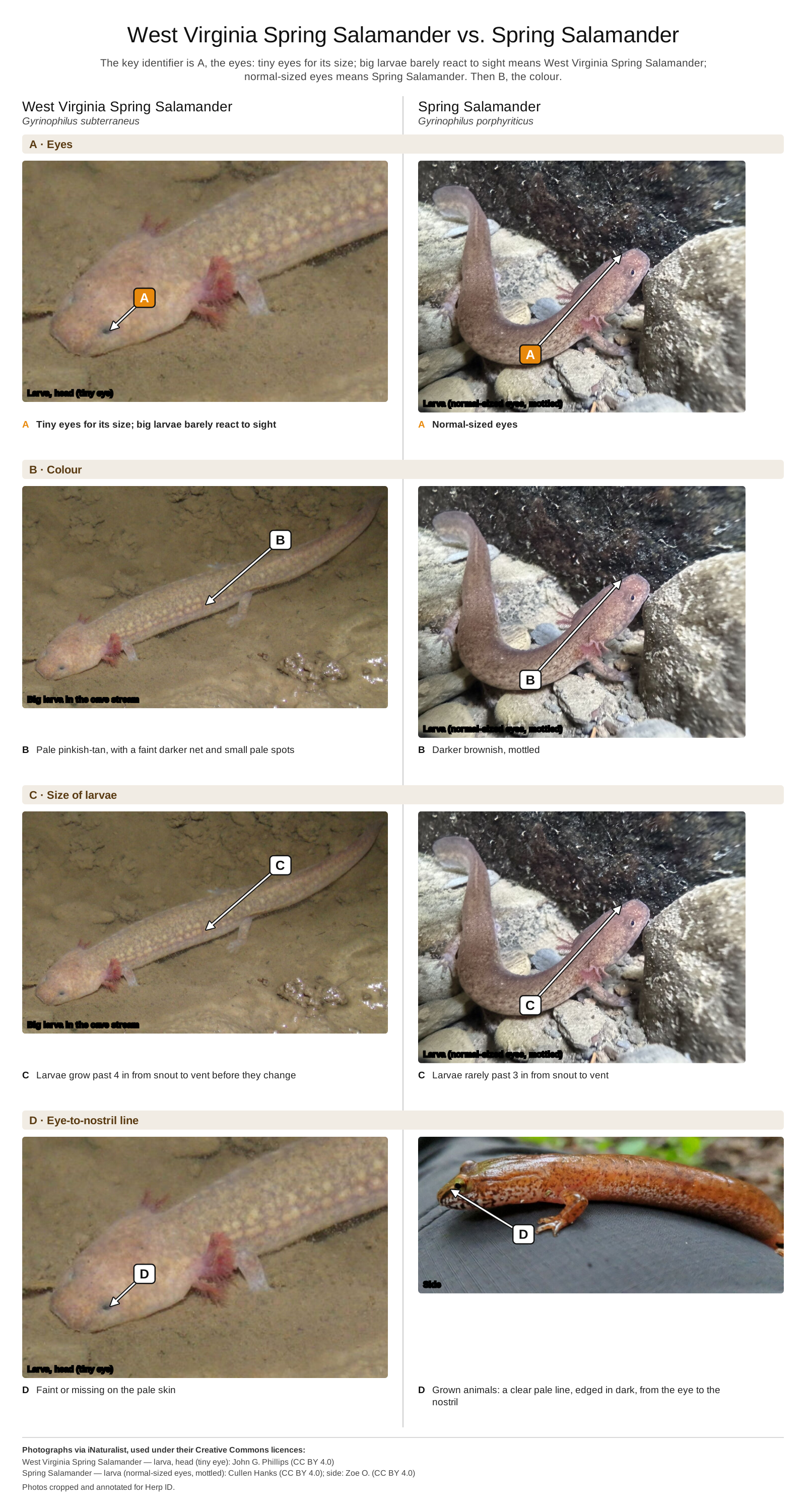
Photographs via iNaturalist under Creative Commons licences; the photographers are credited on the sheet.
More comparisons
- Spring Salamander vs. Red Salamander
- Spring Salamander vs. Midland Mud Salamander
- Spring Salamander vs. Northern Dusky Salamander
- Spring Salamander vs. Allegheny Mountain Dusky Salamander
- Spring Salamander vs. Long-tailed Salamander
- Spring Salamander vs. Cave Salamander
- Mud Salamander vs. Spring Salamander
- Tennessee Cave Salamander vs. Spring Salamander
- Berry Cave Salamander vs. Spring Salamander
Wildsight identifies the reptiles and amphibians of the United States. Every comparison