
Western Leaf-nosed Snake vs. Sidewinder
Both are small, pale, blotched snakes of desert sand at night, and the harmless leaf-nosed snake is often taken for a young Sidewinder; their records overlap widely. A: Small, hardly wider than the neck; no pit in the Western Leaf-nosed Snake; broad and triangular, much wider than the thin neck; a pit between the eye and nostril in the Sidewinder. B: No horn in the Western Leaf-nosed Snake; a raised, pointed horn-like scale in the Sidewinder. The leaf-nosed snake has a big leaf-like scale over the snout and a thin tail with no rattle; the Sidewinder has a rattle. The Sidewinder is venomous: leave it alone.
Open this comparison in Wildsight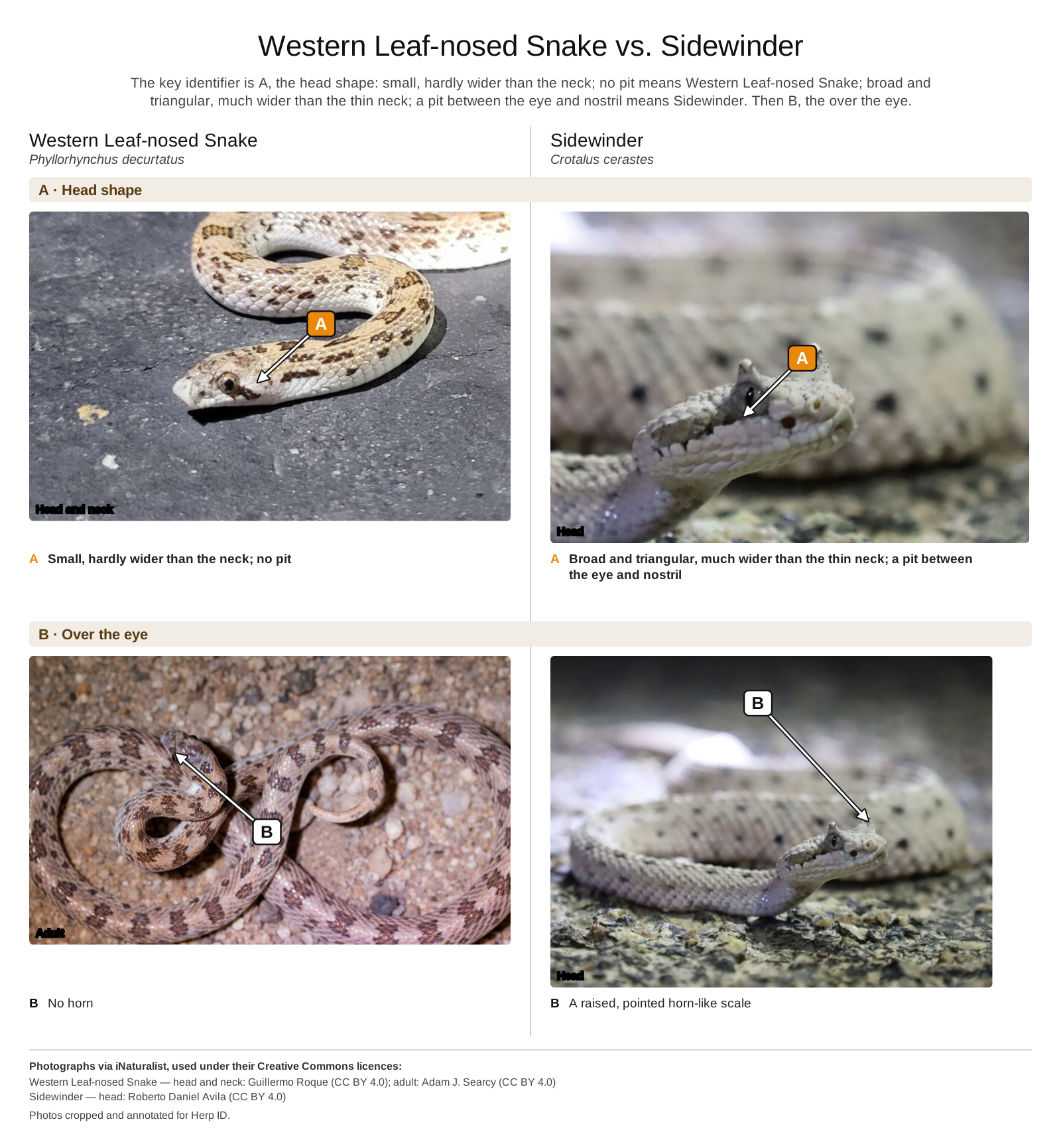
Photographs via iNaturalist under Creative Commons licences; the photographers are credited on the sheet.
More comparisons
- Western Leaf-nosed Snake vs. Coast Night Snake
- Western Leaf-nosed Snake vs. Western Glossy Snake
- Western Leaf-nosed Snake vs. Desert Nightsnake
- California Lyresnake vs. Western Leaf-nosed Snake
- Saddled Leafnose Snake vs. Western Leaf-nosed Snake
- Sidewinder vs. Southwestern Speckled Rattlesnake
- Sidewinder vs. Western Rattlesnake
- Mojave Rattlesnake vs. Sidewinder
- Western Glossy Snake vs. Sidewinder
- Western Diamond-backed Rattlesnake vs. Sidewinder
- Panamint Rattlesnake vs. Sidewinder
- Arizona Black Rattlesnake vs. Sidewinder
- Rock Rattlesnake vs. Sidewinder
- Sidewinder vs. Sonoran Lyre Snake
- Tiger Rattlesnake vs. Sidewinder
- Western Black-tailed Rattlesnake vs. Sidewinder
- Ridge-nosed Rattlesnake vs. Sidewinder
- Twin-spotted Rattlesnake vs. Sidewinder
Wildsight identifies the reptiles and amphibians of the United States. Every comparison