
Baja California Coachwhip vs. Common Coachwhip
The owner's pair. Both live in southern San Diego County, where their records overlap. A: Usually 8; the 4th and 5th touch the eye (hand lens) in the Baja California Coachwhip; 8 (or 7); usually only the 5th (or 4th and 5th) touches the eye (hand lens) in the Common Coachwhip. B: 115 to 135 pairs; the tail longer for the body in the Baja California Coachwhip; 95 to 120 pairs; the tail shorter for the body in the Common Coachwhip. C: Two set phases: dark brown-black with yellow or white side stripes, or grey-green to tan with paired dark crossbands on the neck in the Baja California Coachwhip; red, tan, black-necked or dark in front fading behind, but never dark with yellow side stripes in the Common Coachwhip. A dark coachwhip with crisp yellow side stripes is the Baja California Coachwhip.
Open this comparison in Wildsight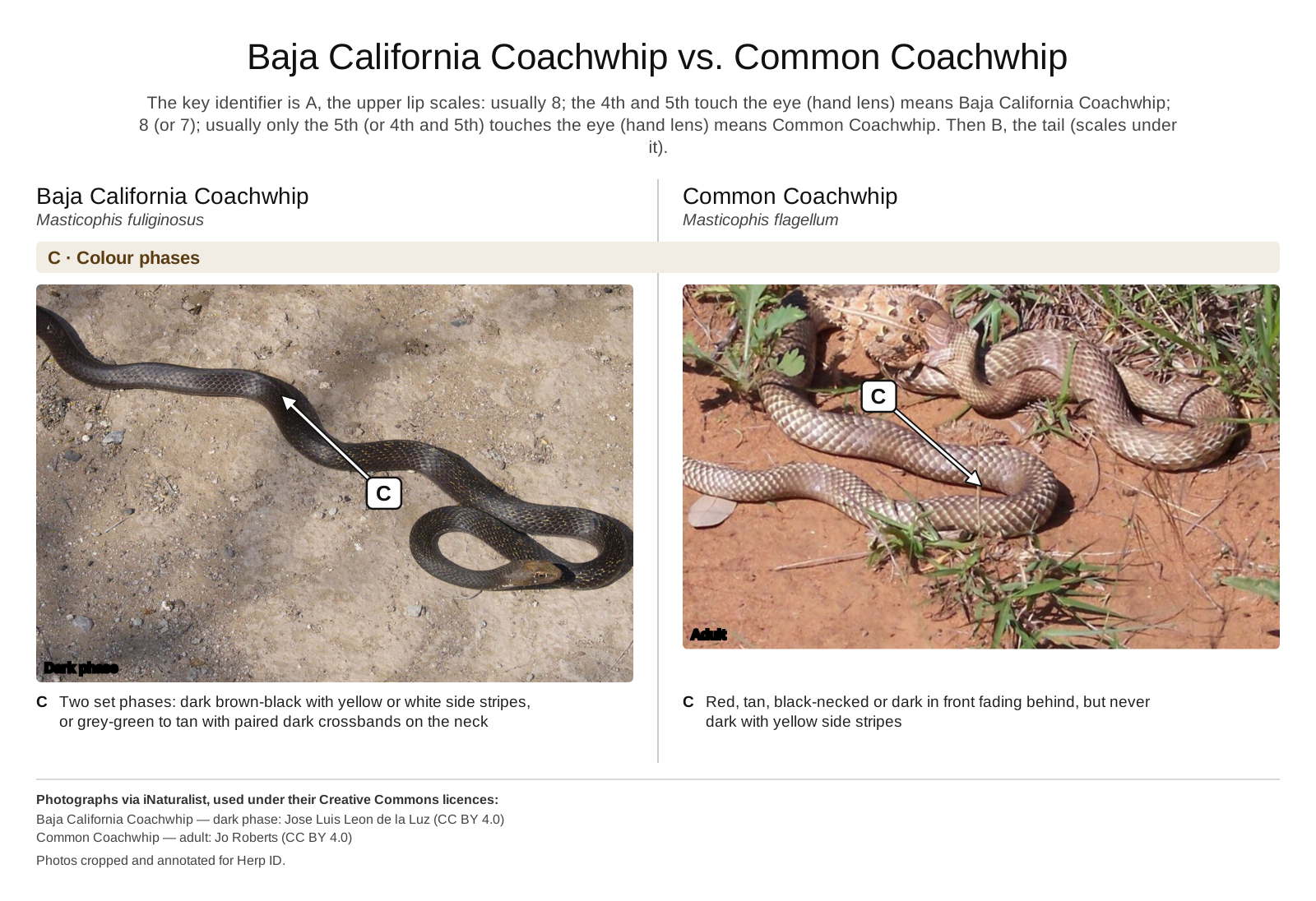
Photographs via iNaturalist under Creative Commons licences; the photographers are credited on the sheet.
More comparisons
- Baja California Coachwhip vs. North American Racer
- Desert Coachwhip vs. Baja California Coachwhip
- Common Coachwhip vs. North American Racer
- Striped Whipsnake vs. Common Coachwhip
- Desert Coachwhip vs. Common Coachwhip
- Sonoran Whipsnake vs. Common Coachwhip
- Desert Kingsnake vs. Common Coachwhip
- Central American Indigo Snake vs. Common Coachwhip
- Schott's Whipsnake vs. Common Coachwhip
- Eastern Indigo Snake vs. Common Coachwhip
Wildsight identifies the reptiles and amphibians of the United States. Every comparison