
Common Coachwhip vs. North American Racer
Both are long, fast, slender snakes with smooth scales that hunt by day. ADULTS. A: Nebraska Coachwhips are light brown to reddish or pinkish tan; Nebraska Racers are plain olive, blue-grey or brown above (black farther east). B: the Racer has a plain white or yellow chin and belly; the Coachwhip's neck may show dark crossbands. The Coachwhip grows longer (over 5 ft) and its tail scales look braided. YOUNG. Both start out patterned. C: the young Coachwhip has narrow dark crossbars, often paired, on the forebody, fading to plain brown on the rear half; the young Racer has a row of rounded brown saddles down the back and small dark spots on the sides, the pattern fading only on the tail. D: the young Coachwhip's head scales are edged in pale, giving a netted head; the young Racer's head is speckled with dark spots, with a white lip.
Open this comparison in Wildsight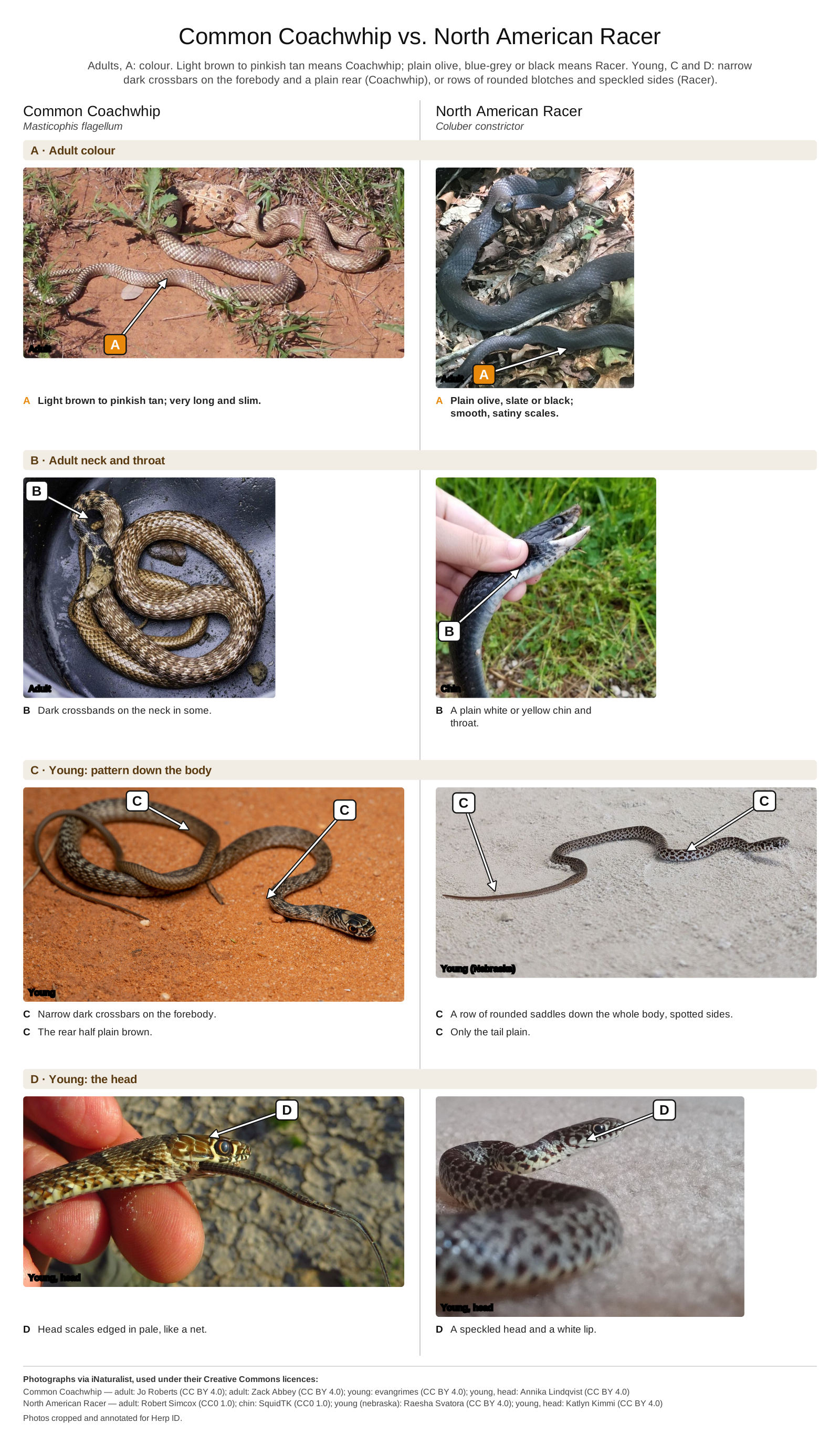
Photographs via iNaturalist under Creative Commons licences; the photographers are credited on the sheet.
More comparisons
- Striped Whipsnake vs. Common Coachwhip
- Baja California Coachwhip vs. Common Coachwhip
- Desert Coachwhip vs. Common Coachwhip
- Sonoran Whipsnake vs. Common Coachwhip
- Desert Kingsnake vs. Common Coachwhip
- Central American Indigo Snake vs. Common Coachwhip
- Schott's Whipsnake vs. Common Coachwhip
- Eastern Indigo Snake vs. Common Coachwhip
- North American Racer vs. Central Ratsnake
- Striped Whipsnake vs. North American Racer
- Striped Racer vs. North American Racer
- Western Patch-nosed Snake vs. North American Racer
- Baja California Coachwhip vs. North American Racer
- Desert Coachwhip vs. North American Racer
- Eastern Ratsnake vs. North American Racer
- Eastern Indigo Snake vs. North American Racer
Wildsight identifies the reptiles and amphibians of the United States. Every comparison