
Granite Spiny Lizard vs. Desert Spiny Lizard
Both live where the granite country meets the Colorado Desert (Anza-Borrego, the Santa Rosa and San Jacinto foothills); their records overlap there. A: Small, flat, smooth scales in the Granite Spiny Lizard; sharply keeled, rough, pointed scales in the Desert Spiny Lizard. B: A broad black collar across the shoulder, edged pale in the Granite Spiny Lizard; a black wedge on each side of the neck, edged pale behind in the Desert Spiny Lizard. C: Rich cobalt blue or violet, dark-edged in the Granite Spiny Lizard; blue or turquoise patch, bordered by the black collar in the Desert Spiny Lizard. D: Olive-brown to purple-black, flecked iridescent blue-green in the Granite Spiny Lizard; tan, straw-yellow or pale grey in the Desert Spiny Lizard. The Granite Spiny's back scales are even spinier and more overlapping. The Granite panel in row A shows the underside of the thigh; no open photo shows its rear surface clearly.
Open this comparison in Wildsight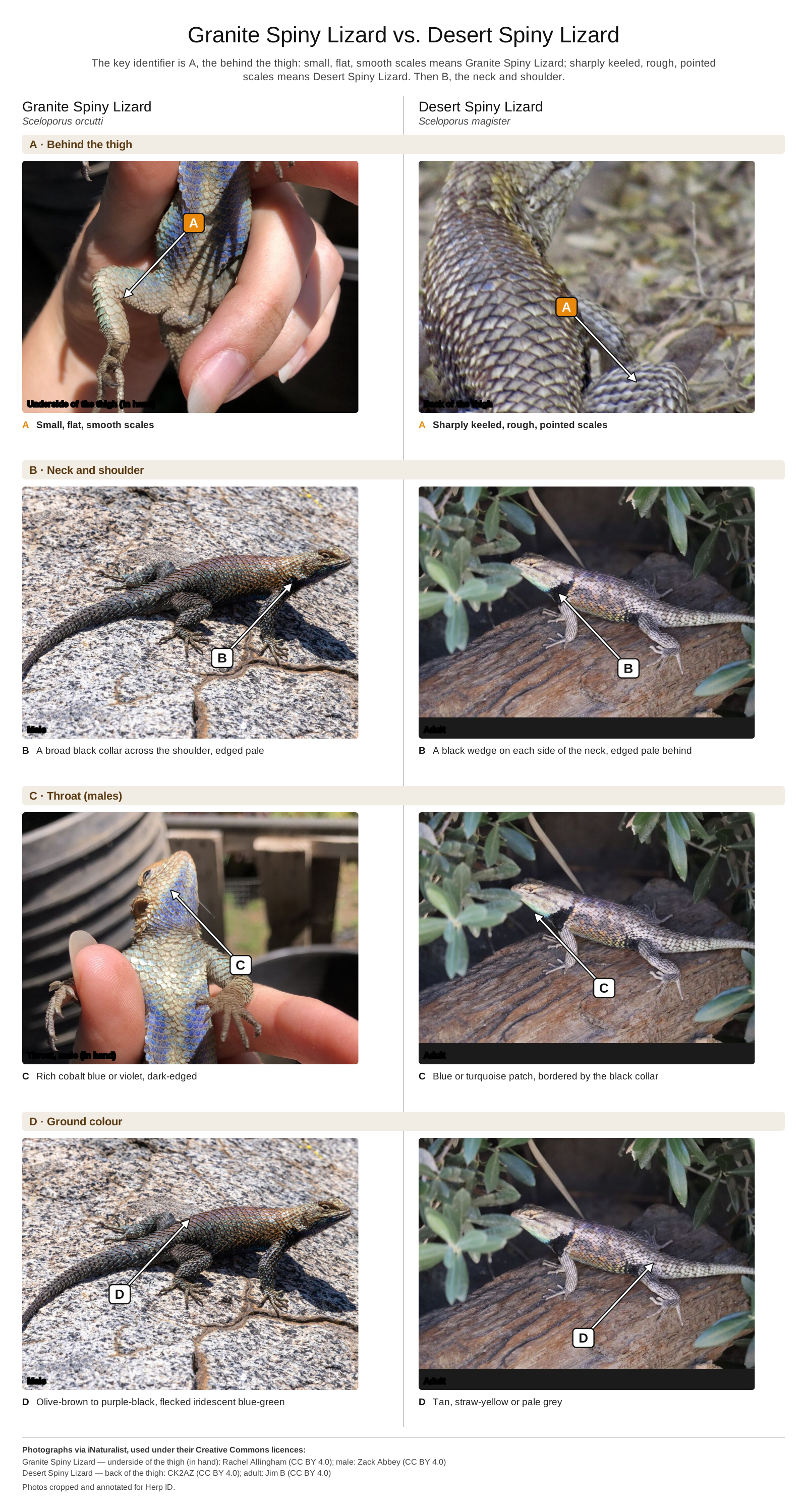
Photographs via iNaturalist under Creative Commons licences; the photographers are credited on the sheet.
More comparisons
- Granite Spiny Lizard vs. Southern Sagebrush Lizard
- Granite Spiny Lizard vs. Western Fence Lizard
- Granite Spiny Lizard vs. Common Side-blotched Lizard
- Granite Spiny Lizard vs. Ornate Tree Lizard
- Banded Rock Lizard vs. Granite Spiny Lizard
- Desert Collared Lizard vs. Granite Spiny Lizard
- Yarrow's Spiny Lizard vs. Granite Spiny Lizard
- Desert Spiny Lizard vs. Southern Sagebrush Lizard
- Desert Spiny Lizard vs. Western Fence Lizard
- Desert Spiny Lizard vs. Common Sagebrush Lizard
- Desert Spiny Lizard vs. Ornate Tree Lizard
- Desert Collared Lizard vs. Desert Spiny Lizard
- Banded Rock Lizard vs. Desert Spiny Lizard
- Yarrow's Spiny Lizard vs. Desert Spiny Lizard
- Clark's Spiny Lizard vs. Desert Spiny Lizard
- Twin-spotted Spiny Lizard vs. Desert Spiny Lizard
Wildsight identifies the reptiles and amphibians of the United States. Every comparison