
Greater Siren vs. Two-toed Amphiuma
The two big eel-like salamanders of the southeastern swamps and ditches; both are often caught on fishing lines. A: Only two small front legs, none at the back in the Greater Siren; four tiny legs, front and hind, each with two toes in the Two-toed Amphiuma. B: Bushy outside gills behind the head in the Greater Siren; no outside gills: only a small slit on each side of the neck in the Two-toed Amphiuma. Amphiumas bite hard; sirens have black dots and yellowish flecks on the sides.
Open this comparison in Wildsight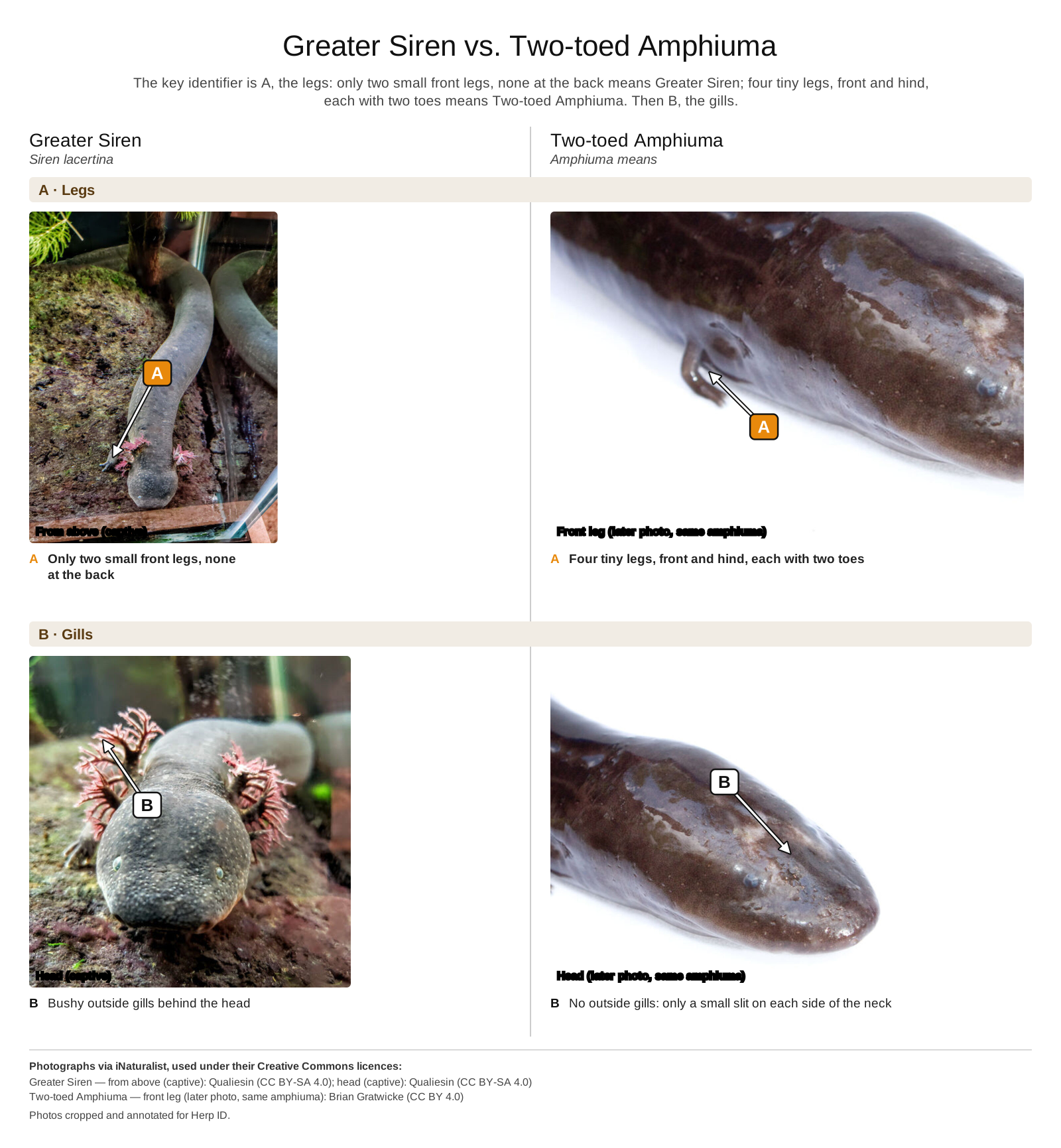
Photographs via iNaturalist under Creative Commons licences; the photographers are credited on the sheet.
More comparisons
- Dwarf Waterdog vs. Greater Siren
- Lesser Siren vs. Greater Siren
- One-toed Amphiuma vs. Greater Siren
- Reticulated Siren vs. Greater Siren
- Apalachicola Waterdog vs. Greater Siren
- Northern Dwarf Siren vs. Greater Siren
- Southern Dwarf Siren vs. Greater Siren
- Rubber Eel vs. Greater Siren
- Dwarf Waterdog vs. Two-toed Amphiuma
- Two-toed Amphiuma vs. Three-toed Amphiuma
- Two-toed Amphiuma vs. Western Lesser Siren
- Two-toed Amphiuma vs. Gulf Coast Waterdog
- Lesser Siren vs. Two-toed Amphiuma
- One-toed Amphiuma vs. Two-toed Amphiuma
- Escambia Waterdog vs. Two-toed Amphiuma
- Seepage Siren vs. Two-toed Amphiuma
- Reticulated Siren vs. Two-toed Amphiuma
- Apalachicola Waterdog vs. Two-toed Amphiuma
- Northern Dwarf Siren vs. Two-toed Amphiuma
- Southern Dwarf Siren vs. Two-toed Amphiuma
- Rubber Eel vs. Two-toed Amphiuma
Wildsight identifies the reptiles and amphibians of the United States. Every comparison