
Orange-throated Whiptail vs. Western Whiptail
Their ranges overlap (checked against both species' records). The Orange-throated Whiptail has an orange throat and clean pale stripes on a dark back with no spots between them; the Western Whiptail has pale stripes broken by dark bars into a checkered pattern, tiny grainy scales and a very long tail. A: Orange-throated Whiptail, an orange throat; Western Whiptail, no collar and no dark blotch behind the front leg. B: Orange-throated Whiptail, tiny, grain-like scales; Western Whiptail, tiny, grain-like scales. C: Orange-throated Whiptail, clean pale stripes on a dark back, no spots between them; Western Whiptail, pale stripes broken by dark bars and spots: checkered.
Open this comparison in Wildsight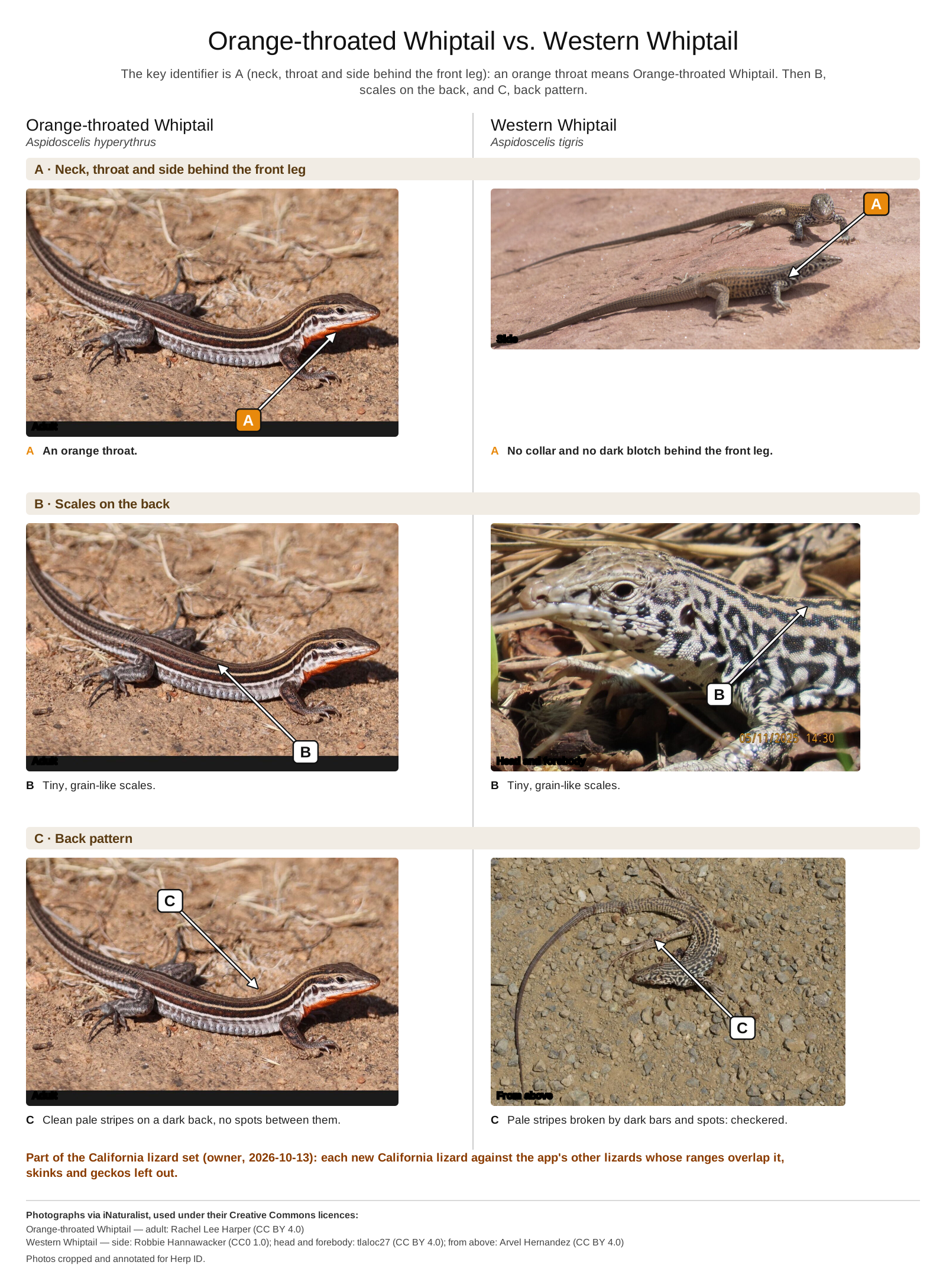
Photographs via iNaturalist under Creative Commons licences; the photographers are credited on the sheet.
More comparisons
- Orange-throated Whiptail vs. Common Side-blotched Lizard
- Orange-throated Whiptail vs. Western Skink
- Orange-throated Whiptail vs. Gilbert's Skink
- Sonoran Spotted Whiptail vs. Orange-throated Whiptail
- African Five-lined Skink vs. Orange-throated Whiptail
- Western Whiptail vs. Long-nosed Leopard Lizard
- Western Fence Lizard vs. Western Whiptail
- Common Side-blotched Lizard vs. Western Whiptail
- Western Whiptail vs. Common Sagebrush Lizard
- Western Whiptail vs. Desert Collared Lizard
- Western Whiptail vs. Northern Alligator Lizard
- Western Whiptail vs. Desert Horned Lizard
- Western Whiptail vs. Pygmy Short-horned Lizard
- Western Whiptail vs. Greater Short-horned Lizard
- Southern Alligator Lizard vs. Western Whiptail
- Plateau Striped Whiptail vs. Western Whiptail
- Italian Wall Lizard vs. Western Whiptail
- Sonoran Spotted Whiptail vs. Western Whiptail
- Desert Grassland Whiptail vs. Western Whiptail
- Chihuahuan Spotted Whiptail vs. Western Whiptail
- Giant Spotted Whiptail vs. Western Whiptail
- Red-backed Whiptail vs. Western Whiptail
- Marbled Whiptail vs. Western Whiptail
- Gray Checkered Whiptail vs. Western Whiptail
Wildsight identifies the reptiles and amphibians of the United States. Every comparison