
Red-backed Whiptail vs. Western Whiptail
Both live in the rocky canyons and desert of south-central Arizona (Organ Pipe, the Ajo Mountains, the Estrellas). A: Light orange tint on top of the lower back (not down the sides) in the Red-backed Whiptail; no orange on the back in the Western Whiptail. B: Light spots joining into upright bars; no dark mottling in the Red-backed Whiptail; dark grey or black net or mottling on the sides and chest in the Western Whiptail. The Red-backed Whiptail is bigger: up to 4.5 in head and body, against 4.3 in.
Open this comparison in Wildsight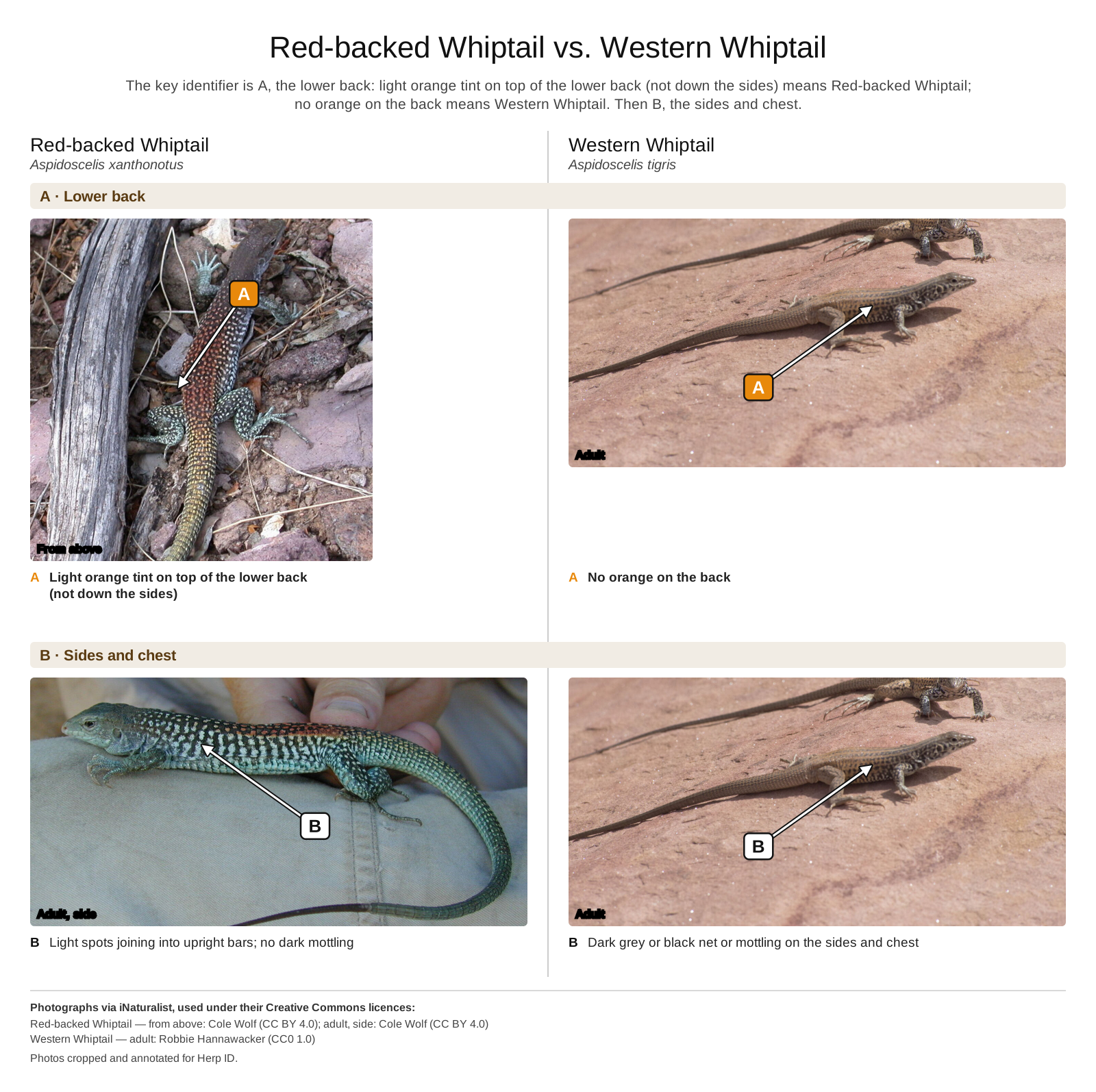
Photographs via iNaturalist under Creative Commons licences; the photographers are credited on the sheet.
More comparisons
- Red-backed Whiptail vs. Giant Spotted Whiptail
- Western Whiptail vs. Long-nosed Leopard Lizard
- Western Fence Lizard vs. Western Whiptail
- Common Side-blotched Lizard vs. Western Whiptail
- Western Whiptail vs. Common Sagebrush Lizard
- Western Whiptail vs. Desert Collared Lizard
- Western Whiptail vs. Northern Alligator Lizard
- Western Whiptail vs. Desert Horned Lizard
- Western Whiptail vs. Pygmy Short-horned Lizard
- Western Whiptail vs. Greater Short-horned Lizard
- Southern Alligator Lizard vs. Western Whiptail
- Plateau Striped Whiptail vs. Western Whiptail
- Orange-throated Whiptail vs. Western Whiptail
- Italian Wall Lizard vs. Western Whiptail
- Sonoran Spotted Whiptail vs. Western Whiptail
- Desert Grassland Whiptail vs. Western Whiptail
- Chihuahuan Spotted Whiptail vs. Western Whiptail
- Giant Spotted Whiptail vs. Western Whiptail
- Marbled Whiptail vs. Western Whiptail
- Gray Checkered Whiptail vs. Western Whiptail
Wildsight identifies the reptiles and amphibians of the United States. Every comparison