
Plateau Fence Lizard vs. Common Sagebrush Lizard
Two spiny lizards of the same genus, both grey-brown with pale side stripes and blue belly patches in males, and both in southwestern Wyoming. A: the Plateau Fence Lizard's back scales are large, keeled and pointed; the Sagebrush Lizard's are smaller and finer. B: the Sagebrush Lizard often has rusty orange in the armpit and a black bar on the shoulder; the Plateau Fence Lizard has neither. The surest mark needs the lizard in hand: the scales on the rear of the thigh are keeled in the Plateau Fence Lizard, mostly tiny and granular in the Sagebrush Lizard.
Open this comparison in Wildsight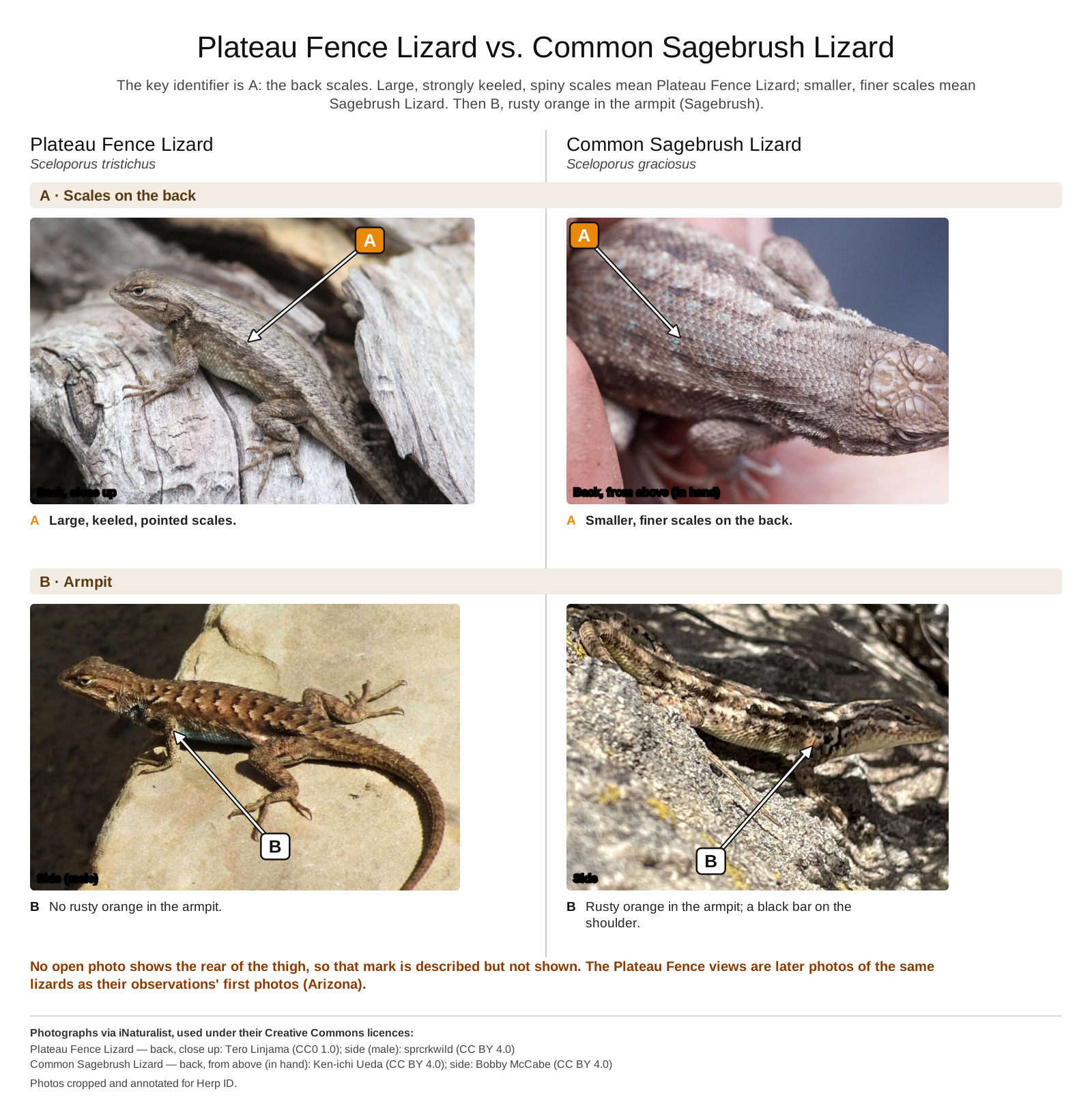
Photographs via iNaturalist under Creative Commons licences; the photographers are credited on the sheet.
More comparisons
- Plateau Fence Lizard vs. Greater Short-horned Lizard
- Plateau Fence Lizard vs. Prairie Lizard
- Plateau Fence Lizard vs. Western Earless Lizard
- Ornate Tree Lizard vs. Plateau Fence Lizard
- Western Fence Lizard vs. Plateau Fence Lizard
- Common Side-blotched Lizard vs. Plateau Fence Lizard
- Plateau Striped Whiptail vs. Plateau Fence Lizard
- Colorado Checkered Whiptail vs. Plateau Fence Lizard
- Southwestern Fence Lizard vs. Plateau Fence Lizard
- Clark's Spiny Lizard vs. Plateau Fence Lizard
- Common Sagebrush Lizard vs. Western Earless Lizard
- Common Sagebrush Lizard vs. Greater Short-horned Lizard
- Common Sagebrush Lizard vs. Prairie Lizard
- Ornate Tree Lizard vs. Common Sagebrush Lizard
- Western Fence Lizard vs. Common Sagebrush Lizard
- Common Side-blotched Lizard vs. Common Sagebrush Lizard
- Western Whiptail vs. Common Sagebrush Lizard
- Long-nosed Leopard Lizard vs. Common Sagebrush Lizard
- Desert Collared Lizard vs. Common Sagebrush Lizard
- Desert Horned Lizard vs. Common Sagebrush Lizard
- Pygmy Short-horned Lizard vs. Common Sagebrush Lizard
- Southern Alligator Lizard vs. Common Sagebrush Lizard
- Plateau Striped Whiptail vs. Common Sagebrush Lizard
- Colorado Checkered Whiptail vs. Common Sagebrush Lizard
Wildsight identifies the reptiles and amphibians of the United States. Every comparison