
Four-lined Skink vs. Common Five-lined Skink
They meet in east-central Texas. The young of both are black with pale lines and a bright blue tail, so look at the lines. A: No pale line down the middle (black in the young, brown in adults) in the Four-lined Skink; a fifth pale line down the middle of the back, forking on the head in the Common Five-lined Skink. B: Short: in most of Texas they end at or just past the front leg (in the Rio Grande Valley they reach the hind leg) in the Four-lined Skink; long: every line runs the whole body onto the tail in the Common Five-lined Skink. C: Brown to grey, the four pale lines still clear in the Four-lined Skink; lines fade with age; old males turn plain brown with an orange-red head in the Common Five-lined Skink. Count the lines on the back: four (two each side) in the Four-lined, five in the Five-lined.
Open this comparison in Wildsight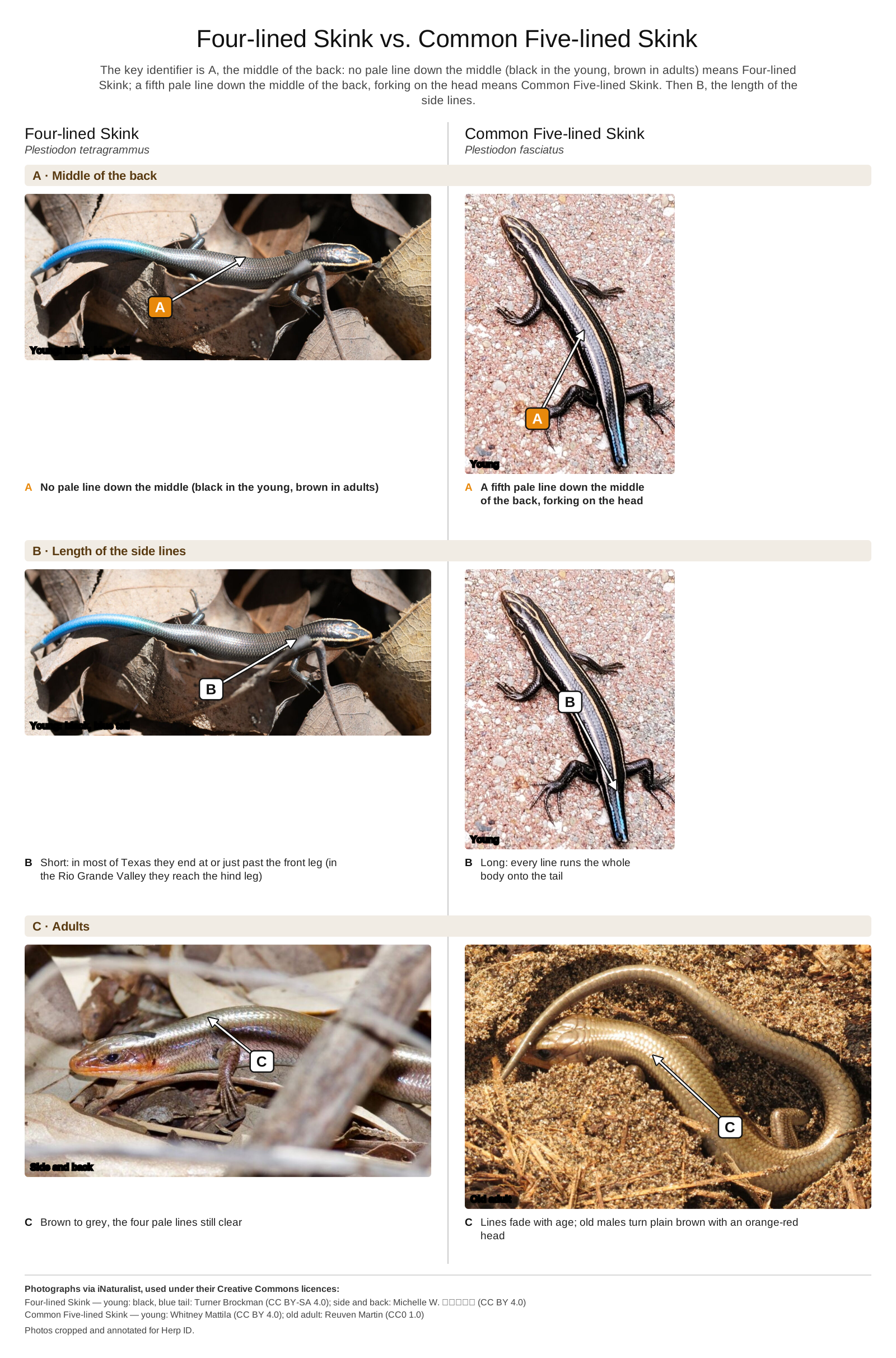
Photographs via iNaturalist under Creative Commons licences; the photographers are credited on the sheet.
More comparisons
- Four-lined Skink vs. Broad-headed Skink
- Four-lined Skink vs. Prairie Skink
- Four-lined Skink vs. Many-lined Skink
- Common Five-lined Skink vs. Broad-headed Skink
- Little Brown Skink vs. Common Five-lined Skink
- Coal Skink vs. Common Five-lined Skink
- Prairie Skink vs. Common Five-lined Skink
- Great Plains Skink vs. Common Five-lined Skink
- Southeastern Five-lined Skink vs. Common Five-lined Skink
- Mole Skink vs. Common Five-lined Skink
Wildsight identifies the reptiles and amphibians of the United States. Every comparison