
Prairie Skink vs. Common Five-lined Skink
Stripe count: the Prairie Skink has four prominent light stripes and lacks a central stripe down the spine; the Common Five-lined has five (one central, two on the back, two low on the sides). Middle of the back: on the Prairie the area between the two upper light stripes is a broad, solid tan or olive band, and its young have only faint lines on the head; on the Five-lined the central stripe forks into a V or Y on top of the head. Ground colour: the Prairie is tan, olive-brown or light grey, pale even between the dark borders of its stripes; the Five-lined is dark brown to jet-black when young, fading to olive-brown in old adults. Head scales: the Prairie lacks the small postnasal scale behind the nostril scale; the Five-lined has one.
Open this comparison in Wildsight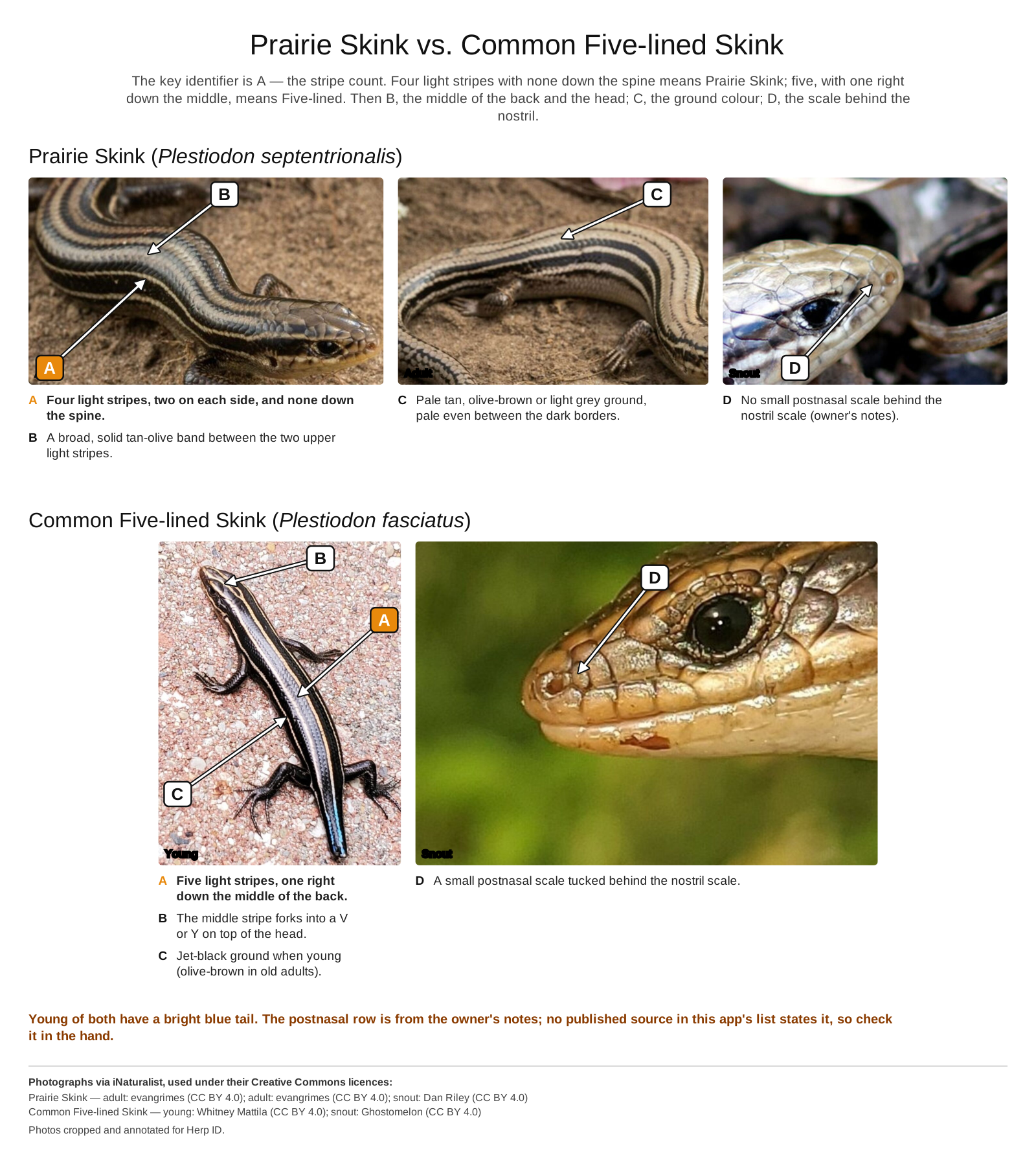
Photographs via iNaturalist under Creative Commons licences; the photographers are credited on the sheet.
More comparisons
- Prairie Skink vs. Little Brown Skink
- Prairie Skink vs. Broad-headed Skink
- Prairie Skink vs. Coal Skink
- Great Plains Skink vs. Prairie Skink
- Four-lined Skink vs. Prairie Skink
- Common Five-lined Skink vs. Broad-headed Skink
- Little Brown Skink vs. Common Five-lined Skink
- Coal Skink vs. Common Five-lined Skink
- Great Plains Skink vs. Common Five-lined Skink
- Four-lined Skink vs. Common Five-lined Skink
- Southeastern Five-lined Skink vs. Common Five-lined Skink
- Mole Skink vs. Common Five-lined Skink
Wildsight identifies the reptiles and amphibians of the United States. Every comparison