
Southeastern Five-lined Skink vs. Common Five-lined Skink
They live side by side across the southeastern states; the Southeastern Five-lined Skink has only a few introduced records in Texas. A: All the scales under the tail are equal in size; the middle row is not widened in the Southeastern Five-lined Skink; the middle row under the tail is broadened, 2 to 3 times wider than the scales beside it in the Common Five-lined Skink. B: Two small, about equal scales between the last lip scale and the ear opening in the Southeastern Five-lined Skink; one large scale there (or none); the lip scales touch the ear margin in the Common Five-lined Skink. C: Usually 30 to 32 scale rows around the middle of the body in the Southeastern Five-lined Skink; usually 26 to 30 (most often 28) scale rows around the middle of the body in the Common Five-lined Skink. Pattern does not separate them: both are striped with a blue tail when young and turn brown with age. Row A is the sure one in the hand.
Open this comparison in Wildsight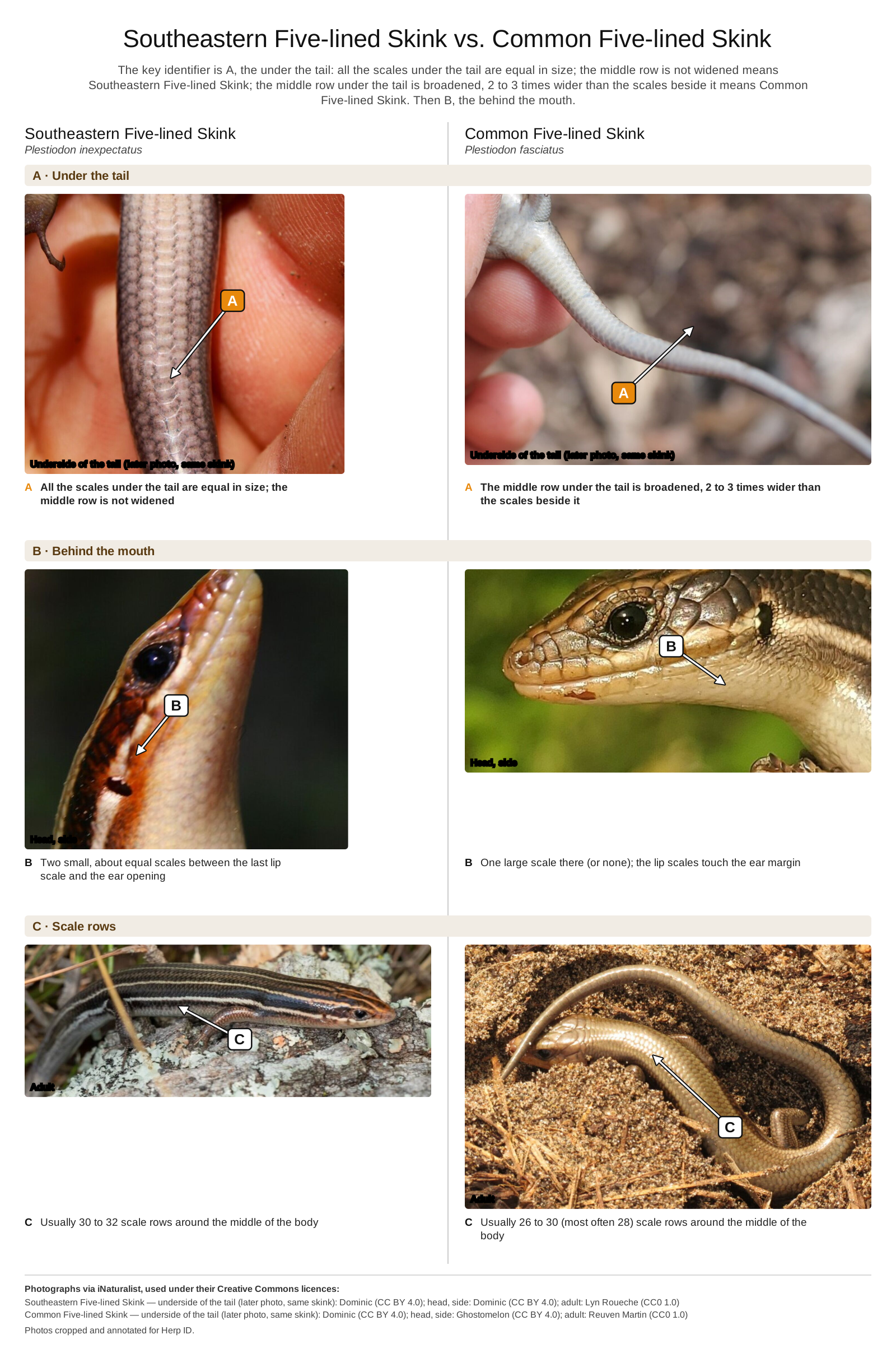
Photographs via iNaturalist under Creative Commons licences; the photographers are credited on the sheet.
More comparisons
- Southeastern Five-lined Skink vs. Broad-headed Skink
- Mole Skink vs. Southeastern Five-lined Skink
- Common Sun Skink vs. Southeastern Five-lined Skink
- Common Five-lined Skink vs. Broad-headed Skink
- Little Brown Skink vs. Common Five-lined Skink
- Coal Skink vs. Common Five-lined Skink
- Prairie Skink vs. Common Five-lined Skink
- Great Plains Skink vs. Common Five-lined Skink
- Four-lined Skink vs. Common Five-lined Skink
- Mole Skink vs. Common Five-lined Skink
Wildsight identifies the reptiles and amphibians of the United States. Every comparison