
Cuban Treefrog vs. Cope's Gray Tree Frog
Cope's Gray Treefrogs live in the same south Louisiana yards and woods (a record within 10 km of 61 of 64 Cuban records); both are warty, grey and blotched. A: Huge toe pads and very large eyes in the Cuban Treefrog; ordinary toe pads and eyes, with a pale spot under the eye in the Cope's Gray Treefrog. B: Yellowish wash on the hidden surfaces, no dark netting in the Cuban Treefrog; bright orange-yellow, mottled with black in the Cope's Gray Treefrog. C: Young: smooth, pale green to tan, with a broad cream stripe along each side and often red eyes in the Cuban Treefrog; young are green or grey with lichen-like blotches and a pale spot under the eye; no cream stripe in the Cope's Gray Treefrog. D: Big: adults 1.5 to 5 in in the Cuban Treefrog; 1.25 to 2 in in the Cope's Gray Treefrog. Introduced: report Cuban Treefrogs to the state wildlife agency and never move one. The skin on a Cuban's head is fused to the skull.
Open this comparison in Wildsight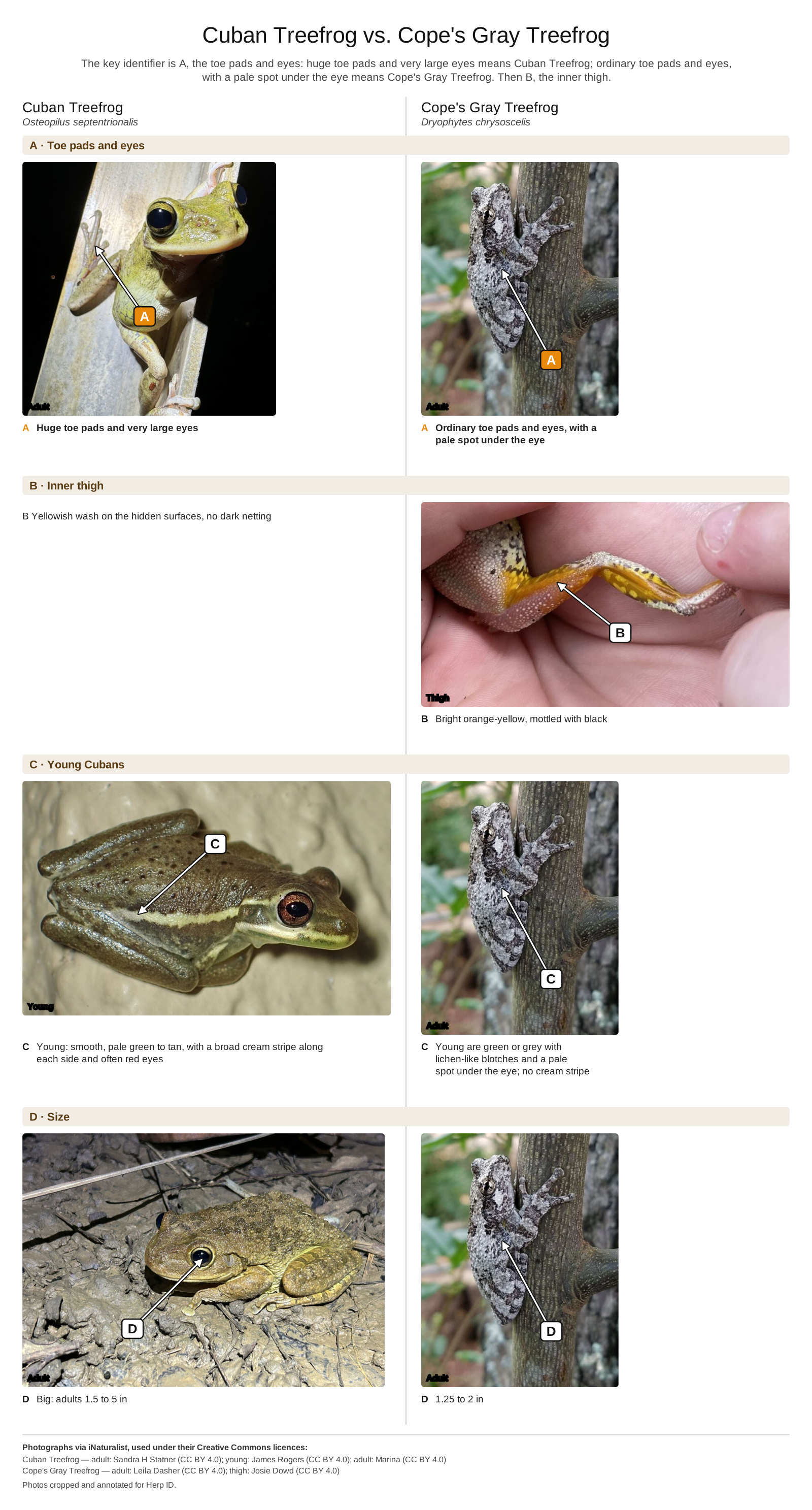
Photographs via iNaturalist under Creative Commons licences; the photographers are credited on the sheet.
More comparisons
- Cuban Treefrog vs. Green Treefrog
- Cuban Treefrog vs. Squirrel Treefrog
- Cuban Treefrog vs. Barking Treefrog
- Cuban Treefrog vs. Pine Woods Treefrog
- Cuban Treefrog vs. Bird-voiced Treefrog
- Green Treefrog vs. Cope's Gray Tree Frog
- Pine Barrens Treefrog vs. Cope's Gray Tree Frog
- Bird-voiced Treefrog vs. Cope's Gray Tree Frog
- Squirrel Treefrog vs. Cope's Gray Tree Frog
- Barking Treefrog vs. Cope's Gray Tree Frog
- Pine Woods Treefrog vs. Cope's Gray Tree Frog
Wildsight identifies the reptiles and amphibians of the United States. Every comparison