
Southern Toad vs. American Toad
The two meet along the inland edge of the Southern Toad's range, from Virginia to Mississippi, and hybridize there; in Louisiana American Toads are few, in the north. A: Tall cranial crests with large, horn-like knobs behind the eyes (biggest in mature females) in the Southern Toad; lower crests; the knob behind the eye relatively smaller in the American Toad. B: Moderately large calf warts compared with the thigh warts in the Southern Toad; very large calf warts, much bigger than the thigh warts in the American Toad. C: Many enlarged warts in the largest spots; the spots often long and streaky in the Southern Toad; usually one or two enlarged warts in the largest spots; spots small, round or tear-shaped in the American Toad. D: Few to no dark spots on the chest and belly, often pale in the Southern Toad; conspicuous dark spots on the chest and belly in the American Toad. E: No knobs yet, but the ridges already tall and fluted in the Southern Toad; big dark spots, often a wishbone-shaped spot between the parotoids in the American Toad. These toads hybridize where they meet: judge by the sum of the checks, not one feature, and use place and call. Calls: Southern about 8 seconds, American usually over 11.
Open this comparison in Wildsight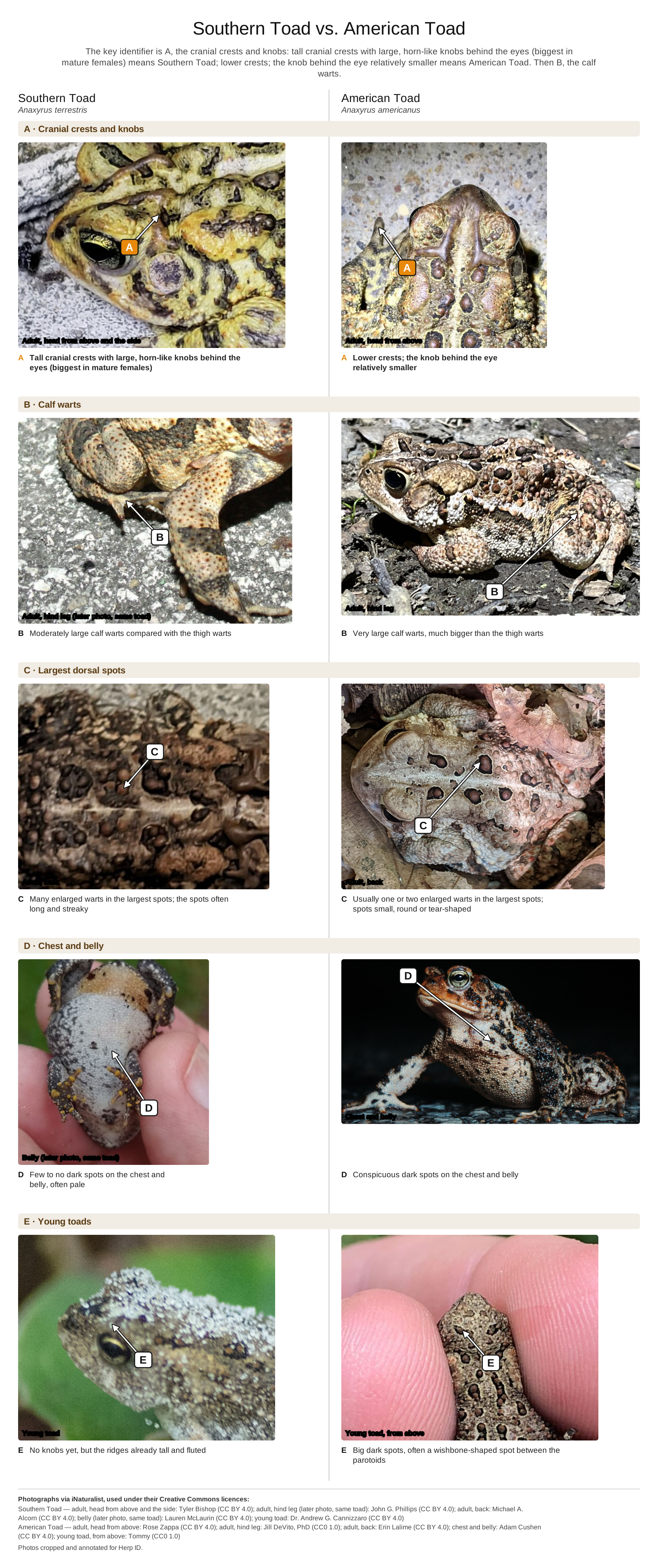
Photographs via iNaturalist under Creative Commons licences; the photographers are credited on the sheet.
More comparisons
- Southern Toad vs. Fowler's Toad
- Southern Toad vs. Gulf Coast Toad
- Southern Toad vs. Oak Toad
- Cane Toad vs. Southern Toad
- American Toad vs. Fowler's Toad
- Eastern Spadefoot vs. American Toad
- Woodhouse's Toad vs. American Toad
- Great Plains Toad vs. American Toad
- Canadian Toad vs. American Toad
- Gulf Coast Toad vs. American Toad
Wildsight identifies the reptiles and amphibians of the United States. Every comparison