
Banded Watersnake vs. Diamondback Watersnake
The owner's pair: their ranges overlap across the Gulf coast (records shared). A: Wide crossbands all the way down in the Banded Watersnake; a dark chain-like net of diamonds, pale between in the Diamondback Watersnake. B: A dark stripe from the eye to the corner of the jaw in the Banded Watersnake; no eye stripe; the side of the head plain, the lips pale in the Diamondback Watersnake. C: Crossbands, often reddish between in the Banded Watersnake; already the chain of dark diamonds on a pale ground in the Diamondback Watersnake.
Open this comparison in Wildsight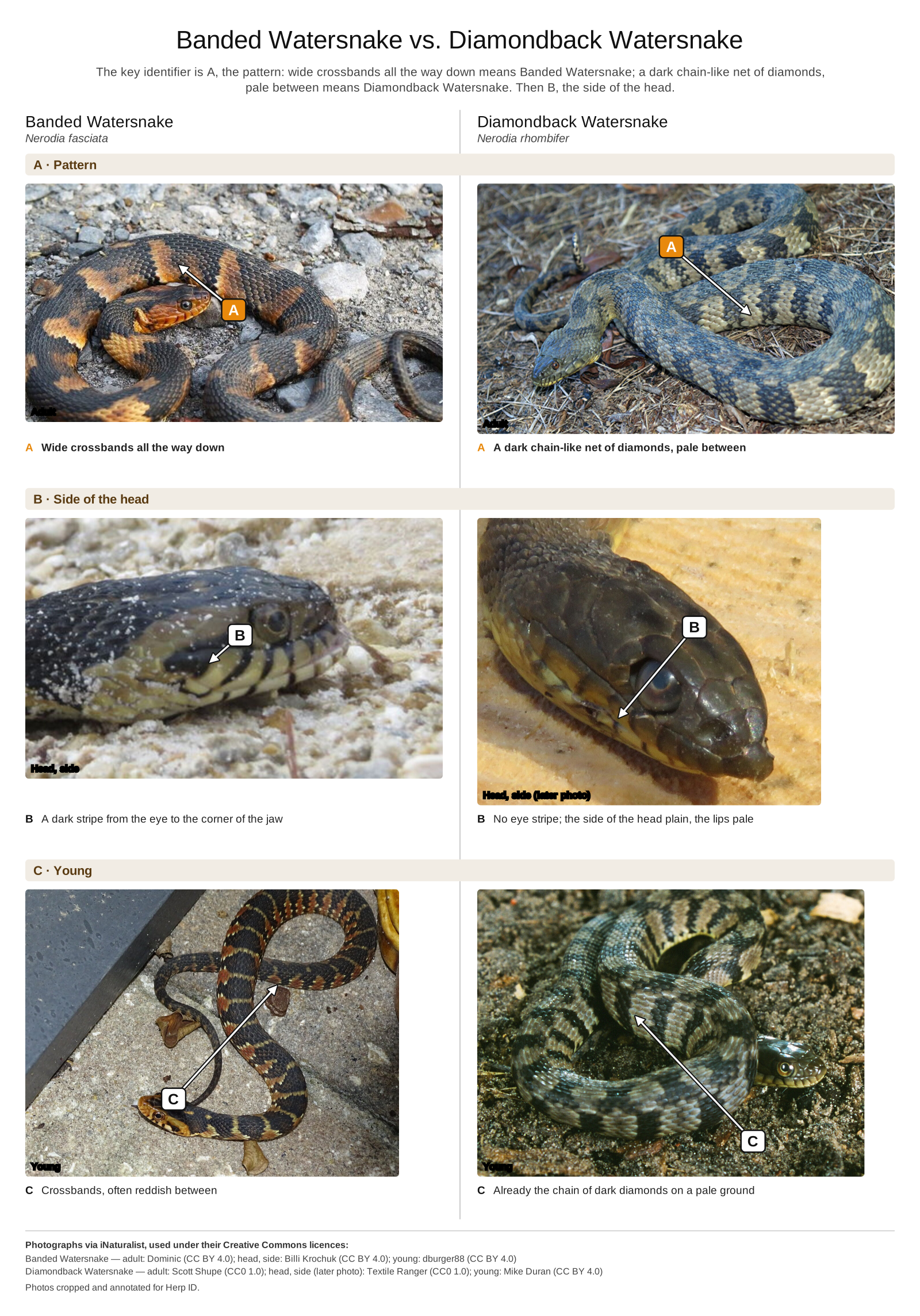
Photographs via iNaturalist under Creative Commons licences; the photographers are credited on the sheet.
More comparisons
- Banded Watersnake vs. Northern Cottonmouth
- Banded Watersnake vs. Plain-bellied Watersnake
- Banded Watersnake vs. Mississippi Green Watersnake
- Banded Watersnake vs. Common Watersnake
- Banded Watersnake vs. Eastern Copperhead
- Broad-banded Copperhead vs. Banded Watersnake
- Glossy Swampsnake vs. Banded Watersnake
- Saltmarsh Snake vs. Banded Watersnake
- Brown Watersnake vs. Banded Watersnake
- Florida Cottonmouth vs. Banded Watersnake
- Florida Green Watersnake vs. Banded Watersnake
- Common Watersnake vs. Diamondback Watersnake
- Eastern Copperhead vs. Diamondback Watersnake
- Plain-bellied Watersnake vs. Diamondback Watersnake
- Northern Cottonmouth vs. Diamondback Watersnake
- Mississippi Green Watersnake vs. Diamondback Watersnake
- Broad-banded Copperhead vs. Diamondback Watersnake
- Glossy Swampsnake vs. Diamondback Watersnake
- Saltmarsh Snake vs. Diamondback Watersnake
- Brazos River Watersnake vs. Diamondback Watersnake
- Concho Watersnake vs. Diamondback Watersnake
Wildsight identifies the reptiles and amphibians of the United States. Every comparison