
Banded Watersnake vs. Eastern Copperhead
Range maps: they overlap across the southeastern states; banded watersnakes are often killed as 'copperheads' and the reverse. A: Narrow, not much wider than the neck; no pit in the Banded Watersnake; broad and triangular on a thin neck; a heat pit; plain copper colour in the Eastern Copperhead. B: Wide dark bands, about even all the way round in the Banded Watersnake; hourglass bands: narrow on the back, wide on the sides in the Eastern Copperhead. C: Round in the Banded Watersnake; vertical, cat-like in the Eastern Copperhead. D: Crossbands, no bright tail tip in the Banded Watersnake; pale hourglass bands and a bright yellow tail tip in the Eastern Copperhead. The Copperhead is venomous. Leave both alone.
Open this comparison in Wildsight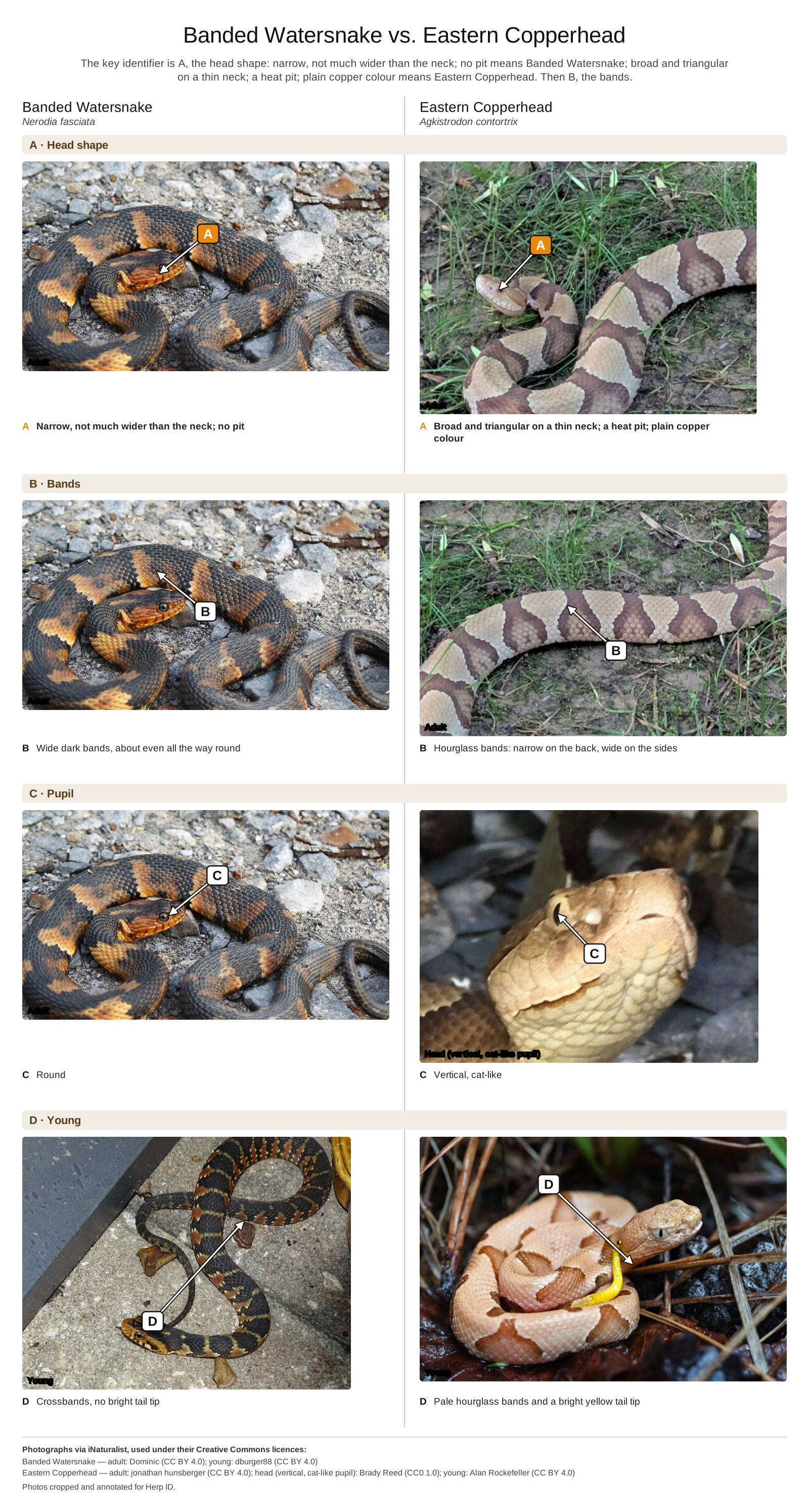
Photographs via iNaturalist under Creative Commons licences; the photographers are credited on the sheet.
More comparisons
- Banded Watersnake vs. Northern Cottonmouth
- Banded Watersnake vs. Diamondback Watersnake
- Banded Watersnake vs. Plain-bellied Watersnake
- Banded Watersnake vs. Mississippi Green Watersnake
- Banded Watersnake vs. Common Watersnake
- Broad-banded Copperhead vs. Banded Watersnake
- Glossy Swampsnake vs. Banded Watersnake
- Saltmarsh Snake vs. Banded Watersnake
- Brown Watersnake vs. Banded Watersnake
- Florida Cottonmouth vs. Banded Watersnake
- Florida Green Watersnake vs. Banded Watersnake
- Eastern Copperhead vs. Common Watersnake
- Eastern Copperhead vs. Diamondback Watersnake
- Eastern Copperhead vs. Plain-bellied Watersnake
- Northern Cottonmouth vs. Eastern Copperhead
- Broad-banded Copperhead vs. Eastern Copperhead
- Mole Kingsnake vs. Eastern Copperhead
- Brown Watersnake vs. Eastern Copperhead
- Florida Cottonmouth vs. Eastern Copperhead
Wildsight identifies the reptiles and amphibians of the United States. Every comparison