
Broad-banded Copperhead vs. Eastern Copperhead
The owner's pair. Range first: the Broad-banded Copperhead lives in central and west-central Texas, Oklahoma, southern Kansas and northern Mexico; the Eastern Copperhead across the eastern United States, from eastern Texas and the Gulf Coast north to southern New England and west to the Mississippi Valley. Outside the hybrid zone where they meet (in Kansas mostly between the Verdigris and Walnut rivers) place alone tells them apart (records share 21 one-degree squares). A: Very broad (7 to 10 scale rows wide) and even, hardly narrowing over the spine in the Broad-banded Copperhead; hourglass-shaped, narrowing sharply to 2 or 3 scale rows over the spine in the Eastern Copperhead. In Kansas the Eastern is found north and east of the Neosho basin, the Broad-banded in the Chautauqua Hills, the southern Flint Hills and Cowley County; snakes from the zone between can be in between. Both are venomous: leave them alone.
Open this comparison in Wildsight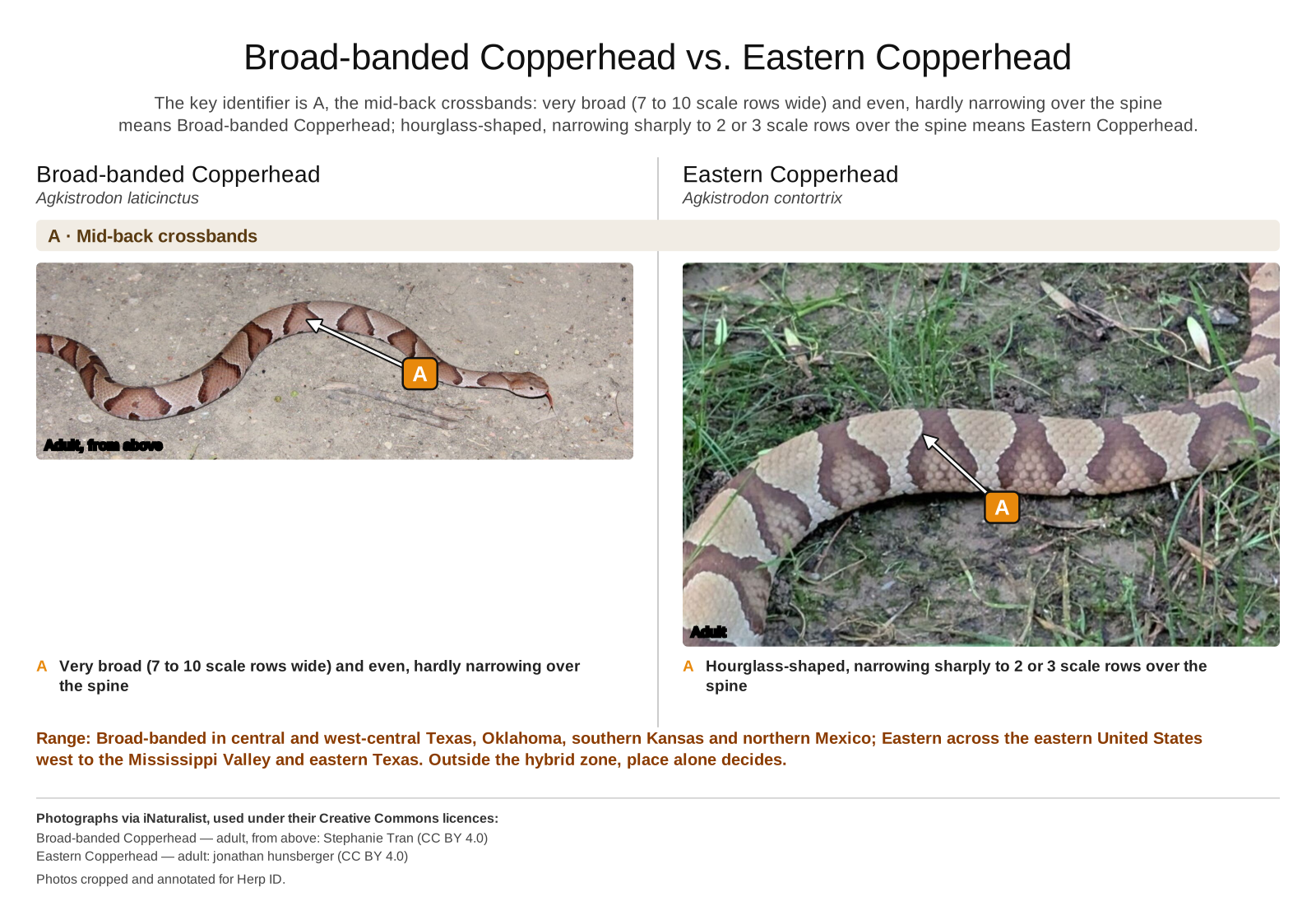
Photographs via iNaturalist under Creative Commons licences; the photographers are credited on the sheet.
More comparisons
- Broad-banded Copperhead vs. Northern Cottonmouth
- Broad-banded Copperhead vs. Common Watersnake
- Broad-banded Copperhead vs. Plain-bellied Watersnake
- Broad-banded Copperhead vs. Diamondback Watersnake
- Broad-banded Copperhead vs. Banded Watersnake
- Eastern Copperhead vs. Common Watersnake
- Eastern Copperhead vs. Diamondback Watersnake
- Eastern Copperhead vs. Plain-bellied Watersnake
- Northern Cottonmouth vs. Eastern Copperhead
- Banded Watersnake vs. Eastern Copperhead
- Mole Kingsnake vs. Eastern Copperhead
- Brown Watersnake vs. Eastern Copperhead
- Florida Cottonmouth vs. Eastern Copperhead
Wildsight identifies the reptiles and amphibians of the United States. Every comparison