
Broad-banded Copperhead vs. Northern Cottonmouth
Both are venomous pit vipers of southeastern Kansas, Oklahoma and Texas (records share 28 one-degree squares). A: A plain copper or tan head with no stripe through the eye in the Broad-banded Copperhead; a dark band through the eye, bordered by a pale line; a white mouth gaped in threat in the Northern Cottonmouth. B: Pale tan with broad, crisp chestnut bands in the Broad-banded Copperhead; dark olive to black; the ragged bands fade with age until many look plain dark in the Northern Cottonmouth. C: Young: pale grey-tan bands and no face stripe in the Broad-banded Copperhead; young: bold dark-edged bands and already the dark stripe through the eye in the Northern Cottonmouth. The cottonmouth lives in and beside water and is very rare in Kansas (far southeastern Cherokee County). Both are venomous: leave them alone.
Open this comparison in Wildsight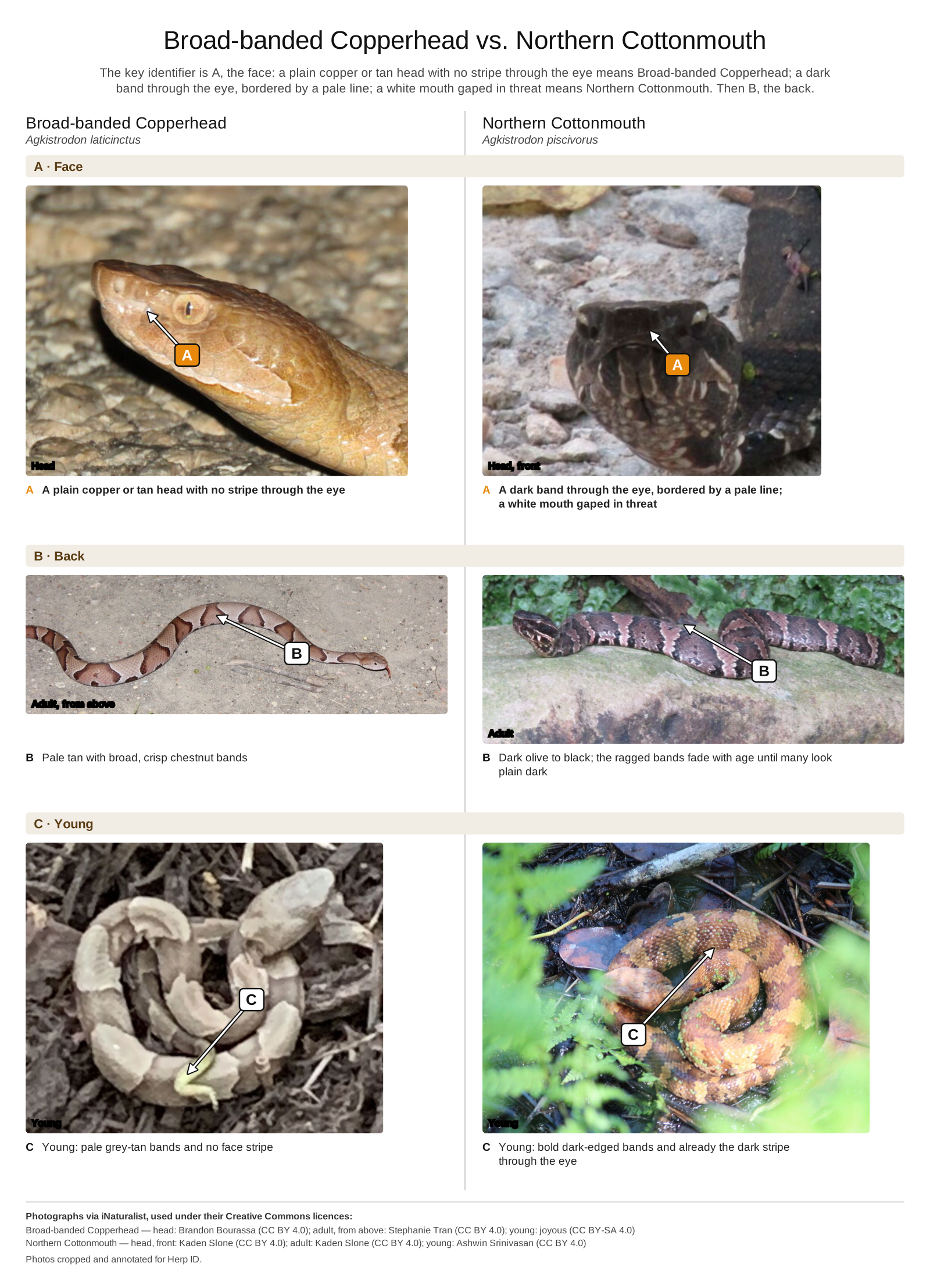
Photographs via iNaturalist under Creative Commons licences; the photographers are credited on the sheet.
More comparisons
- Broad-banded Copperhead vs. Eastern Copperhead
- Broad-banded Copperhead vs. Common Watersnake
- Broad-banded Copperhead vs. Plain-bellied Watersnake
- Broad-banded Copperhead vs. Diamondback Watersnake
- Broad-banded Copperhead vs. Banded Watersnake
- Northern Cottonmouth vs. Common Watersnake
- Northern Cottonmouth vs. Plain-bellied Watersnake
- Northern Cottonmouth vs. Diamondback Watersnake
- Northern Cottonmouth vs. Mississippi Green Watersnake
- Northern Cottonmouth vs. Eastern Copperhead
- Banded Watersnake vs. Northern Cottonmouth
- Brown Watersnake vs. Northern Cottonmouth
- Florida Cottonmouth vs. Northern Cottonmouth
- Florida Green Watersnake vs. Northern Cottonmouth
Wildsight identifies the reptiles and amphibians of the United States. Every comparison