
Broad-banded Copperhead vs. Common Watersnake
Common Watersnakes are killed as 'copperheads' more often than any other snake; they meet in eastern Kansas and Oklahoma (records share 14 one-degree squares). A: A broad head with a heat pit between the eye and the nostril in the Broad-banded Copperhead; a narrower head with no pit in the Common Watersnake. B: The same broad bands from neck to tail in the Broad-banded Copperhead; crossbands near the head that break into alternating blotches toward the tail in the Common Watersnake. C: Vertical, cat-like in the Broad-banded Copperhead; round in the Common Watersnake. D: Young: a bright yellow or greenish tail tip in the Broad-banded Copperhead; young: bold dark blotches and no bright tail tip in the Common Watersnake. The copperhead is venomous: leave it alone.
Open this comparison in Wildsight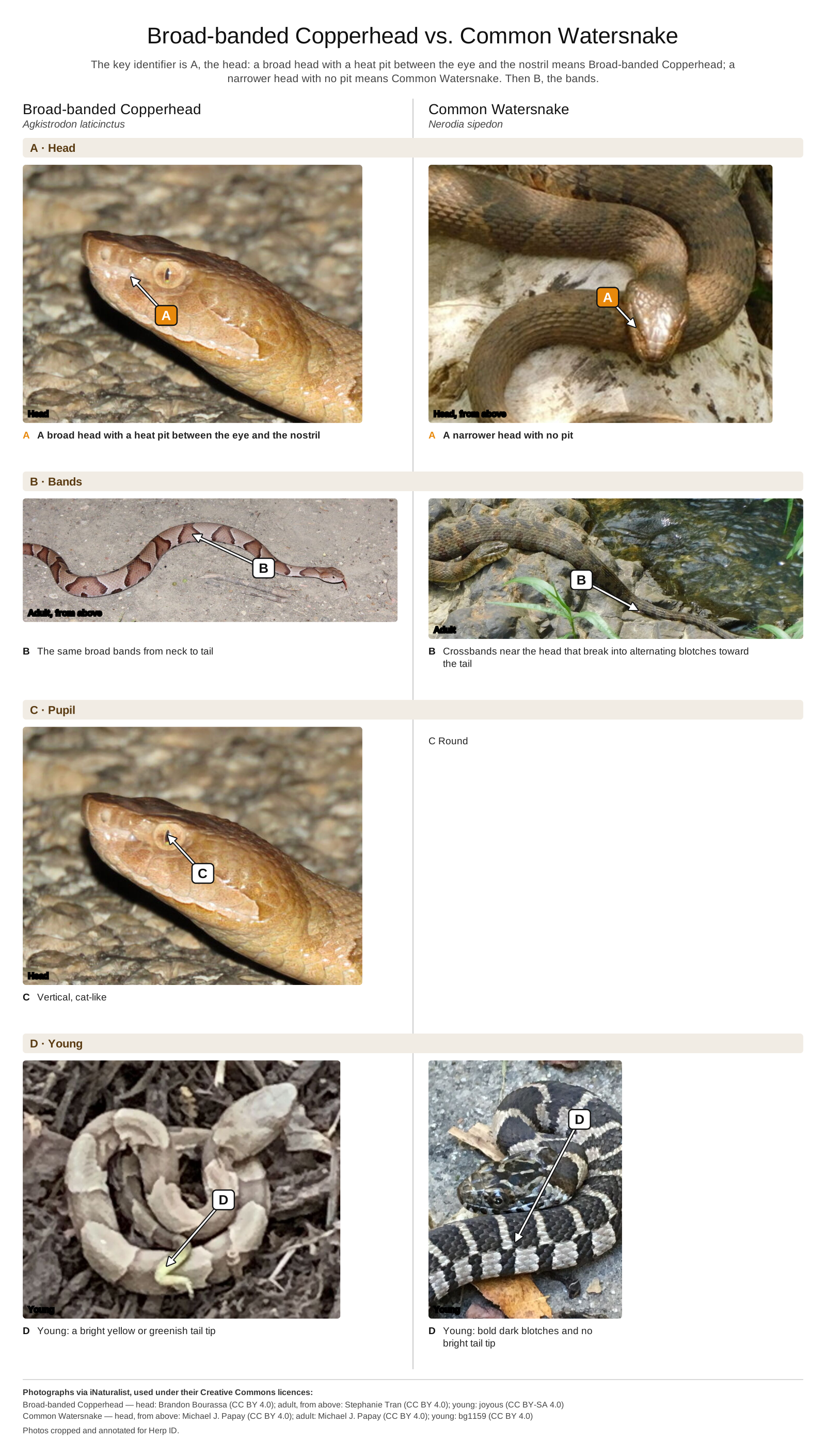
Photographs via iNaturalist under Creative Commons licences; the photographers are credited on the sheet.
More comparisons
- Broad-banded Copperhead vs. Eastern Copperhead
- Broad-banded Copperhead vs. Northern Cottonmouth
- Broad-banded Copperhead vs. Plain-bellied Watersnake
- Broad-banded Copperhead vs. Diamondback Watersnake
- Broad-banded Copperhead vs. Banded Watersnake
- Eastern Copperhead vs. Common Watersnake
- Common Watersnake vs. Diamondback Watersnake
- Common Watersnake vs. Plain-bellied Watersnake
- Kirtland's Snake vs. Common Watersnake
- Queensnake vs. Common Watersnake
- Northern Cottonmouth vs. Common Watersnake
- Mississippi Green Watersnake vs. Common Watersnake
- Graham's Crawfish Snake vs. Common Watersnake
- Banded Watersnake vs. Common Watersnake
- Glossy Swampsnake vs. Common Watersnake
- Brown Watersnake vs. Common Watersnake
Wildsight identifies the reptiles and amphibians of the United States. Every comparison