
Common Watersnake vs. Diamondback Watersnake
Both are heavy brown watersnakes with keeled scales and half-moons on the belly. On a Common Watersnake the dark marks are separate: crossbands near the head, then blotches on the back alternating with blotches on the sides. On a Diamondback the dark marks join at their corners into a chain or net that leaves pale diamond-shaped patches down the back. Young of both are boldly marked and easy to confuse — look for whether the bands stay separate or link into a chain. Diamondbacks are known in Indiana only from the lower Wabash and Ohio in the far southwest.
Open this comparison in Wildsight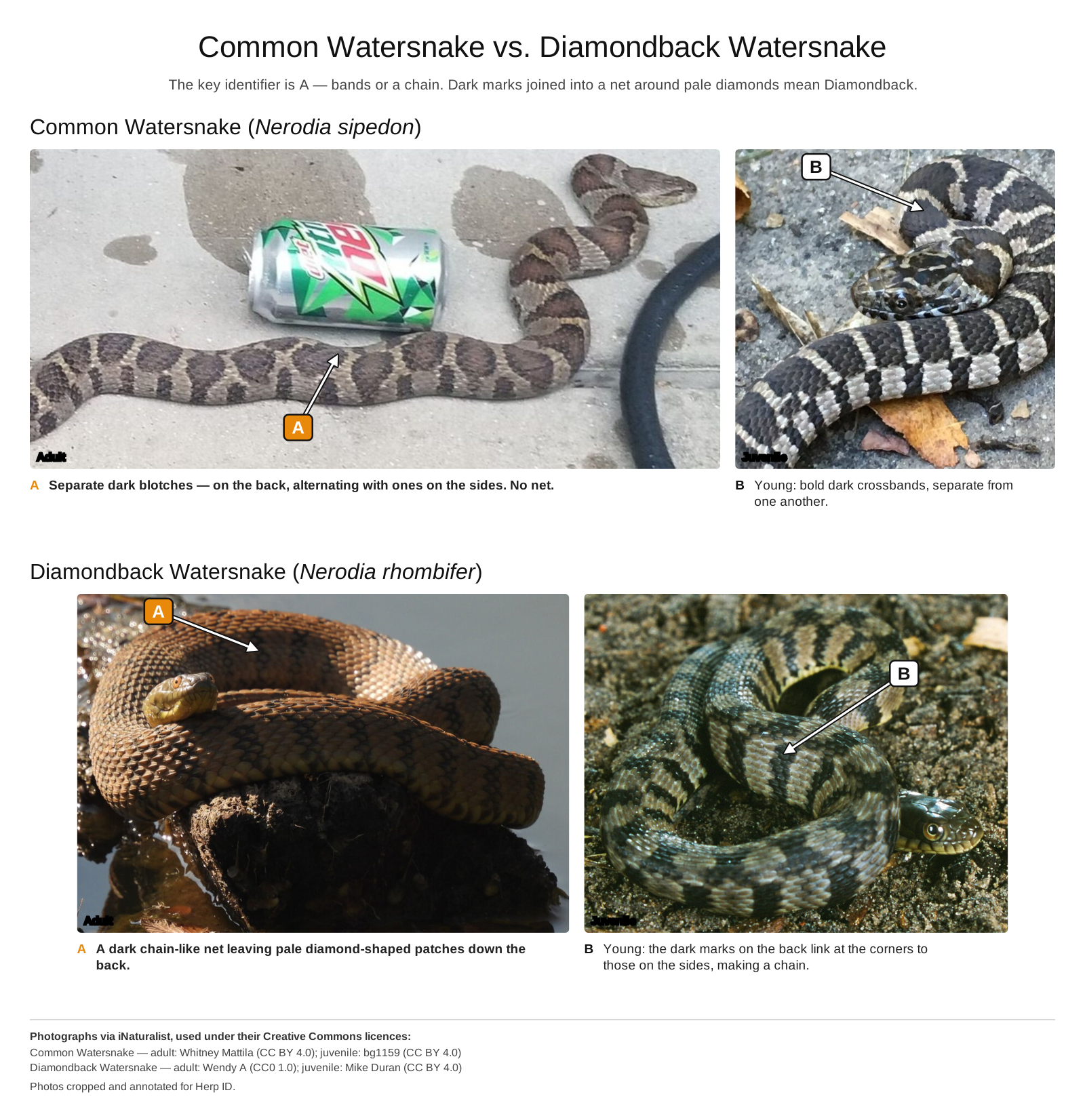
Photographs via iNaturalist under Creative Commons licences; the photographers are credited on the sheet.
More comparisons
- Eastern Copperhead vs. Common Watersnake
- Common Watersnake vs. Plain-bellied Watersnake
- Kirtland's Snake vs. Common Watersnake
- Queensnake vs. Common Watersnake
- Northern Cottonmouth vs. Common Watersnake
- Mississippi Green Watersnake vs. Common Watersnake
- Graham's Crawfish Snake vs. Common Watersnake
- Banded Watersnake vs. Common Watersnake
- Broad-banded Copperhead vs. Common Watersnake
- Glossy Swampsnake vs. Common Watersnake
- Brown Watersnake vs. Common Watersnake
- Eastern Copperhead vs. Diamondback Watersnake
- Plain-bellied Watersnake vs. Diamondback Watersnake
- Northern Cottonmouth vs. Diamondback Watersnake
- Mississippi Green Watersnake vs. Diamondback Watersnake
- Banded Watersnake vs. Diamondback Watersnake
- Broad-banded Copperhead vs. Diamondback Watersnake
- Glossy Swampsnake vs. Diamondback Watersnake
- Saltmarsh Snake vs. Diamondback Watersnake
- Brazos River Watersnake vs. Diamondback Watersnake
- Concho Watersnake vs. Diamondback Watersnake
Wildsight identifies the reptiles and amphibians of the United States. Every comparison