
Eastern Copperhead vs. Common Watersnake
The most common snake mix-up in Indiana, and the one that gets harmless watersnakes killed. Look at the bands from above: a Copperhead's are hourglass-shaped, pinched narrow over the spine and wide on the sides. A Common Watersnake's run the other way — wide over the spine, breaking into alternating blotches down the body. A close look at the head settles it: the Copperhead has a vertical pupil and a pit between the eye and the nostril, the watersnake a round pupil and no pit. Watch either from a distance; do not pick one up to check.
Open this comparison in Wildsight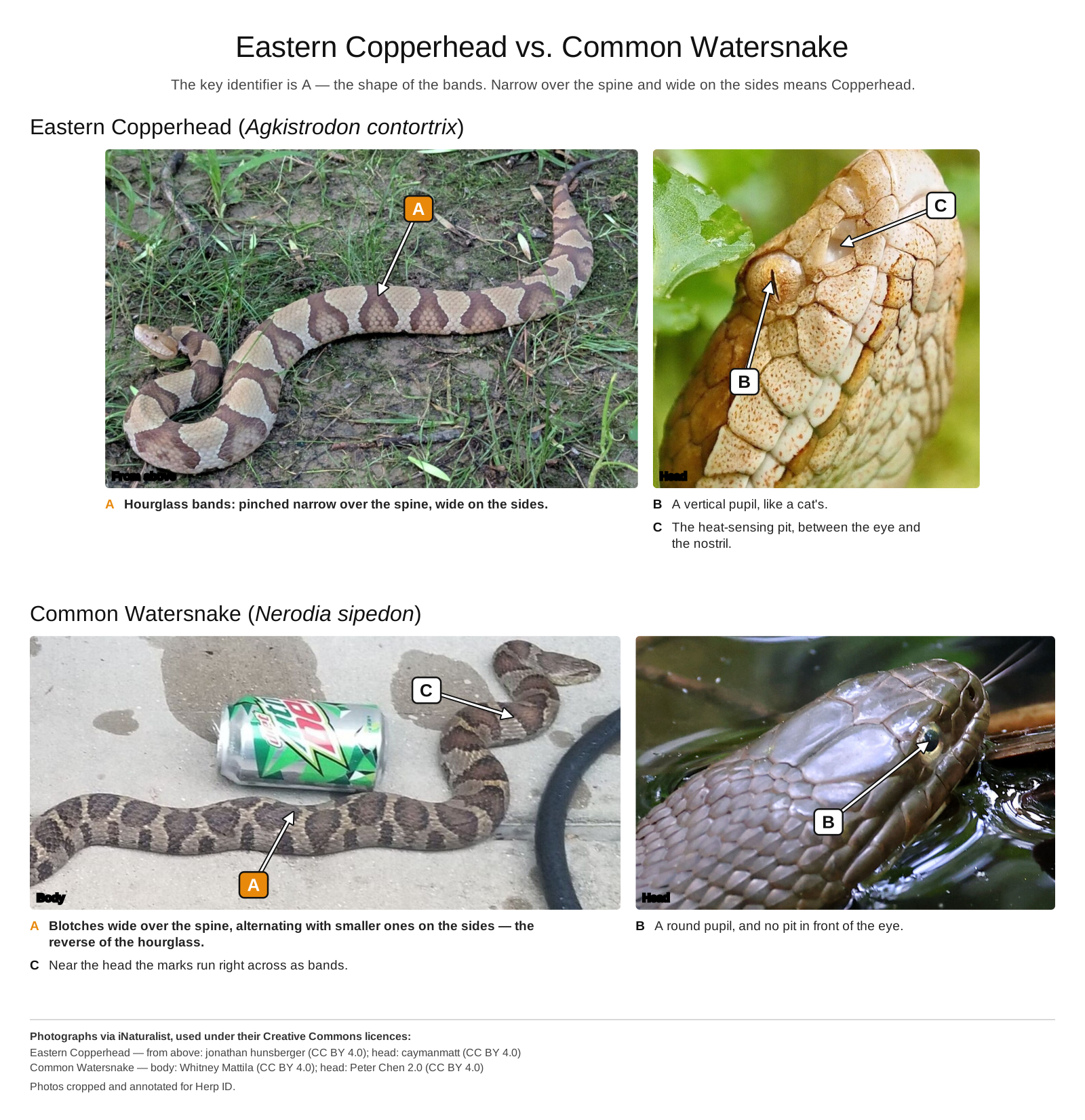
Photographs via iNaturalist under Creative Commons licences; the photographers are credited on the sheet.
More comparisons
- Eastern Copperhead vs. Diamondback Watersnake
- Eastern Copperhead vs. Plain-bellied Watersnake
- Northern Cottonmouth vs. Eastern Copperhead
- Banded Watersnake vs. Eastern Copperhead
- Broad-banded Copperhead vs. Eastern Copperhead
- Mole Kingsnake vs. Eastern Copperhead
- Brown Watersnake vs. Eastern Copperhead
- Florida Cottonmouth vs. Eastern Copperhead
- Common Watersnake vs. Diamondback Watersnake
- Common Watersnake vs. Plain-bellied Watersnake
- Kirtland's Snake vs. Common Watersnake
- Queensnake vs. Common Watersnake
- Northern Cottonmouth vs. Common Watersnake
- Mississippi Green Watersnake vs. Common Watersnake
- Graham's Crawfish Snake vs. Common Watersnake
- Banded Watersnake vs. Common Watersnake
- Broad-banded Copperhead vs. Common Watersnake
- Glossy Swampsnake vs. Common Watersnake
- Brown Watersnake vs. Common Watersnake
Wildsight identifies the reptiles and amphibians of the United States. Every comparison