
Banded Watersnake vs. Common Watersnake
Range maps: they meet across the Gulf states, from Louisiana to the Carolinas (54 shared one-degree squares of records). A: A dark stripe from the eye to the corner of the jaw in the Banded Watersnake; no dark stripe from the eye; dark bars on the lip scales in the Common Watersnake. B: Wide dark crossbands all the way to the tail in the Banded Watersnake; crossbands near the head breaking into alternating back and side blotches toward the tail in the Common Watersnake. C: Yellowish, with dark squarish spots or wavy lines, often reddish at the sides (no open photo shows it) in the Banded Watersnake; pale, with reddish or black half-moons (no open photo shows it) in the Common Watersnake. D: Crossbands all the way down, often reddish between; the eye stripe already there in the Banded Watersnake; high-contrast dark crossbands on grey near the head, breaking into alternating blotches behind; no eye stripe in the Common Watersnake. Both bite and smear musk; neither is venomous.
Open this comparison in Wildsight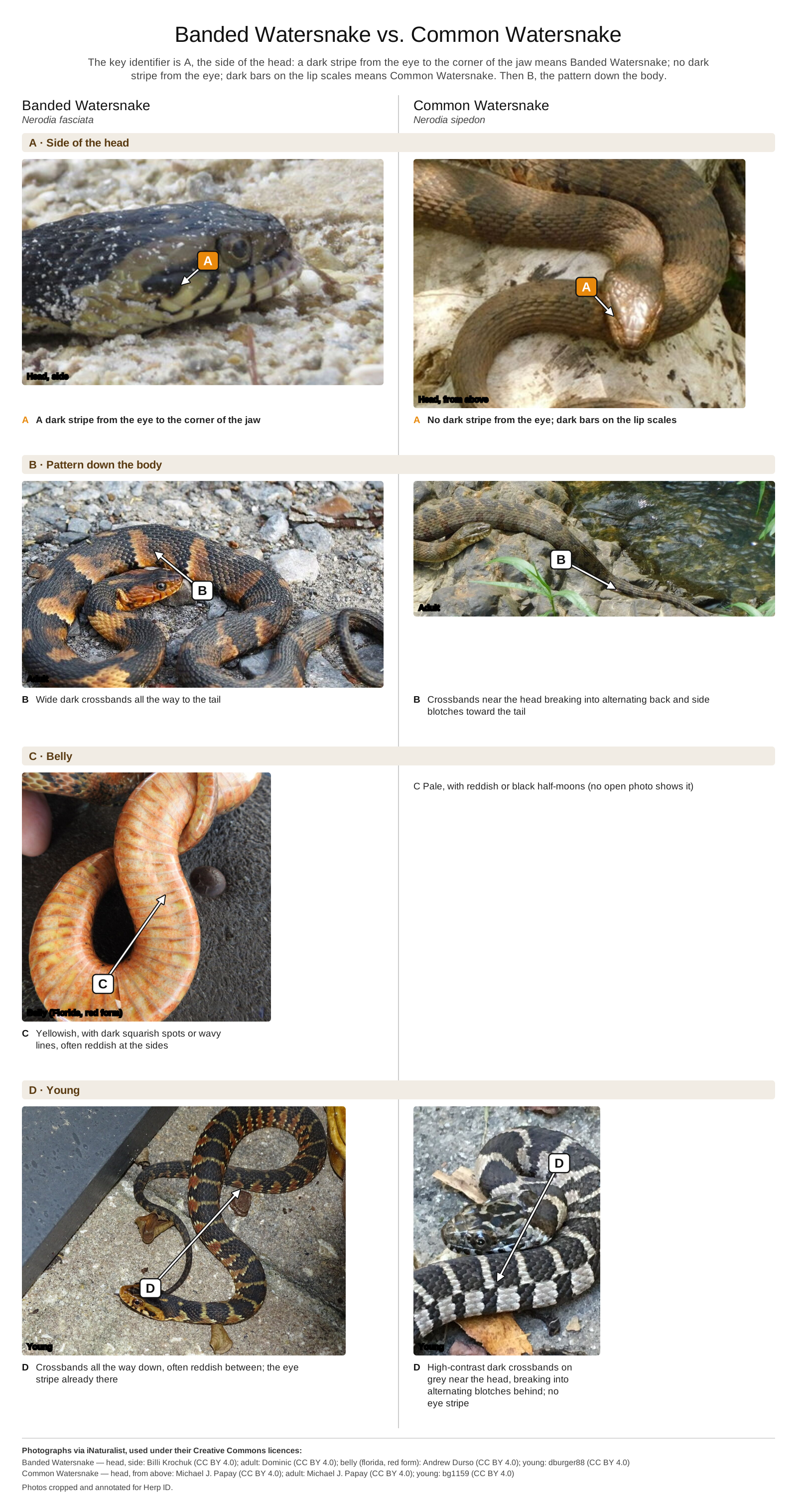
Photographs via iNaturalist under Creative Commons licences; the photographers are credited on the sheet.
More comparisons
- Banded Watersnake vs. Northern Cottonmouth
- Banded Watersnake vs. Diamondback Watersnake
- Banded Watersnake vs. Plain-bellied Watersnake
- Banded Watersnake vs. Mississippi Green Watersnake
- Banded Watersnake vs. Eastern Copperhead
- Broad-banded Copperhead vs. Banded Watersnake
- Glossy Swampsnake vs. Banded Watersnake
- Saltmarsh Snake vs. Banded Watersnake
- Brown Watersnake vs. Banded Watersnake
- Florida Cottonmouth vs. Banded Watersnake
- Florida Green Watersnake vs. Banded Watersnake
- Eastern Copperhead vs. Common Watersnake
- Common Watersnake vs. Diamondback Watersnake
- Common Watersnake vs. Plain-bellied Watersnake
- Kirtland's Snake vs. Common Watersnake
- Queensnake vs. Common Watersnake
- Northern Cottonmouth vs. Common Watersnake
- Mississippi Green Watersnake vs. Common Watersnake
- Graham's Crawfish Snake vs. Common Watersnake
- Broad-banded Copperhead vs. Common Watersnake
- Glossy Swampsnake vs. Common Watersnake
- Brown Watersnake vs. Common Watersnake
Wildsight identifies the reptiles and amphibians of the United States. Every comparison