
Kanawha Blackbelly Salamander vs. Northern Dusky Salamander
Both are keel-tailed brown duskies of the same streams in the north-east corner and Virginia. A: Heavy, with a big head; up to 7 in in the Kanawha Blackbelly Salamander; smaller, with a small head; up to about 5 in in the Northern Dusky Salamander. B: Small whitish dots along each side in the Kanawha Blackbelly Salamander; dull brown, any pattern faint; no rows of dots in the Northern Dusky Salamander. C: Black in adults in the Kanawha Blackbelly Salamander; pale, mottled grey-brown in the Northern Dusky Salamander.
Open this comparison in Wildsight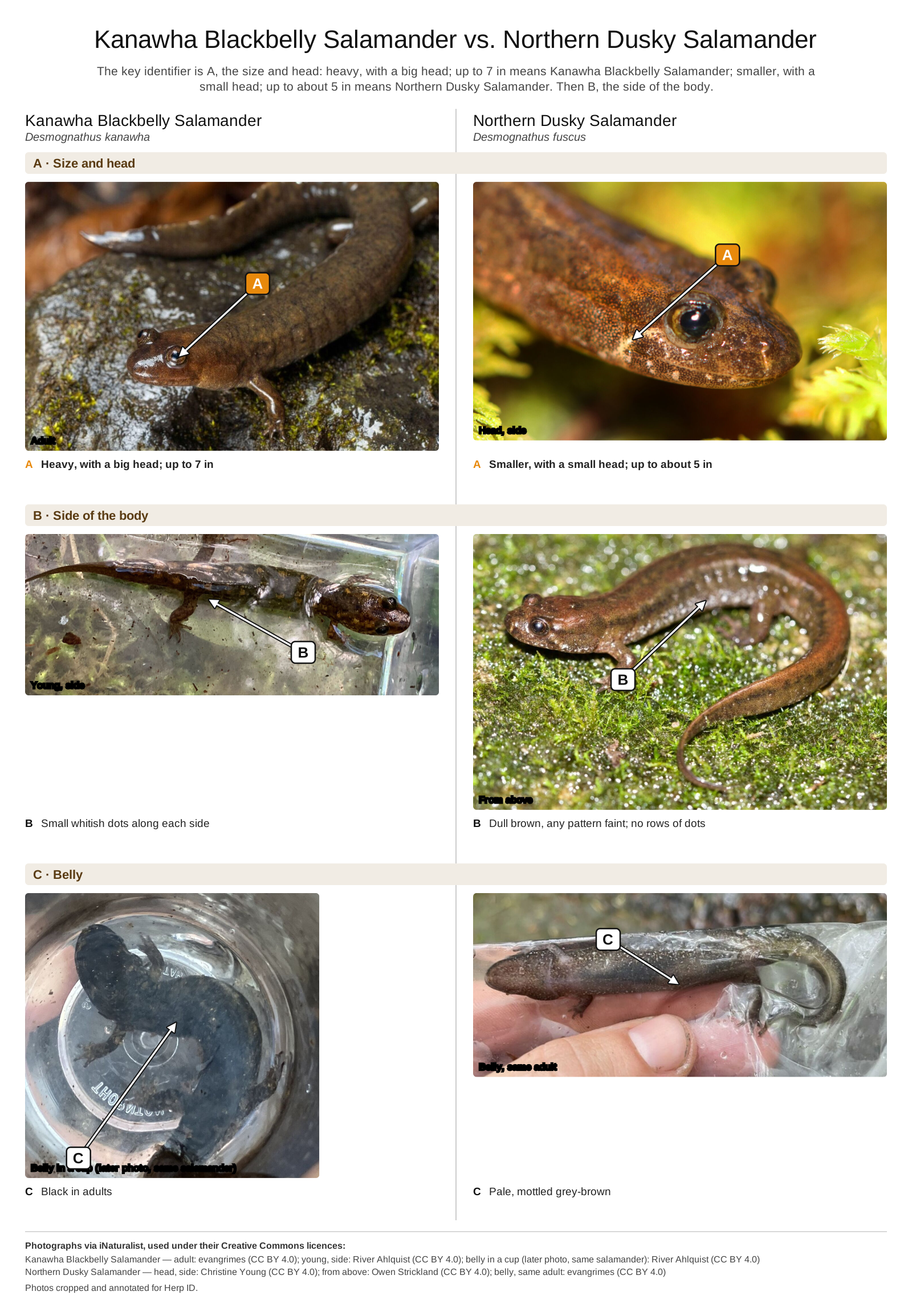
Photographs via iNaturalist under Creative Commons licences; the photographers are credited on the sheet.
More comparisons
- Kanawha Blackbelly Salamander vs. Seal Salamander
- Kanawha Blackbelly Salamander vs. Northern Shovel-nosed Salamander
- Southern Two-lined Salamander vs. Northern Dusky Salamander
- Northern Dusky Salamander vs. Eastern Red-backed Salamander
- Northern Zigzag Salamander vs. Northern Dusky Salamander
- Four-toed Salamander vs. Northern Dusky Salamander
- Northern Ravine Salamander vs. Northern Dusky Salamander
- Northern Two-lined Salamander vs. Northern Dusky Salamander
- Allegheny Mountain Dusky Salamander vs. Northern Dusky Salamander
- Spring Salamander vs. Northern Dusky Salamander
- Valley and Ridge Salamander vs. Northern Dusky Salamander
- Wehrle's Salamander vs. Northern Dusky Salamander
- Seal Salamander vs. Northern Dusky Salamander
- Spotted Dusky Salamander vs. Northern Dusky Salamander
- Ravine Salamander vs. Northern Dusky Salamander
- Black Mountain Salamander vs. Northern Dusky Salamander
- Southern Zigzag Salamander vs. Northern Dusky Salamander
- Blue Ridge Blackbelly Salamander vs. Northern Dusky Salamander
- Blue Ridge Dusky Salamander vs. Northern Dusky Salamander
- Cumberland Dusky Salamander vs. Northern Dusky Salamander
- Shenandoah Mountain Salamander vs. Northern Dusky Salamander
- Flat-headed Salamander vs. Northern Dusky Salamander
Wildsight identifies the reptiles and amphibians of the United States. Every comparison